We were recently en route to
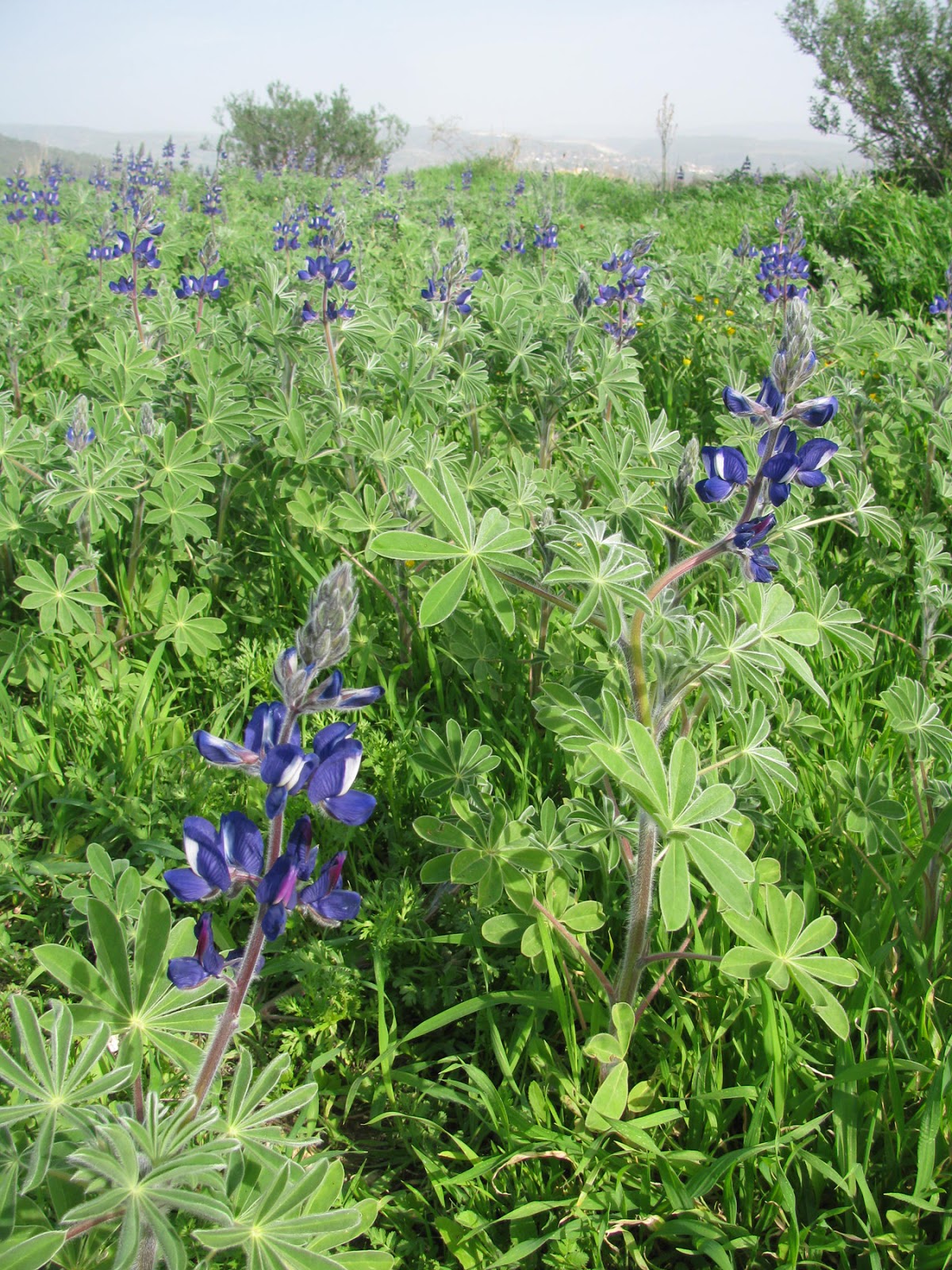
Lupin Hill to see the gorgeous purple lupin in full bloom when we saw a flash of red by the side of the road. The peak season for Israel's wildflowers is mid-February to late March, so we knew that what we had seen were red anemones, or in Hebrew,
calaniot. Of course we pulled over to take a look.
It turned out that the red anemones were in fact blooming on Tel Beit Shemesh (or
Tell er-Rumeileh, the Arabic name meaning "the little sandy knoll"), the ruins of the ancient biblical city located near the modern city of
Beit Shemesh. The ancient city of Beit Shemesh ("House of the Sun" or "Temple of the Sun" in Hebrew) was originally named after the
Canaanite sun-goddess
Shemesh, who was worshipped there in ancient times. Beit Shemesh was an important Biblical city during the Canaanite (Bronze age) and
Israelite (Iron age) periods. It was a border city, located at the meeting point of three civilisations - Canaanites, Israelites and
Philistines - and it is mentioned in connection with the return of the
Ark of the Covenant by the Philistines (the Philistines decided to return the stolen Ark of the Covenant back to Israel, since it caused them plagues. They returned it to Beit Shemesh on a cart. The residents of Beit Shemesh peeked into the Ark, so G-d killed them), as well as other historical events.
Several important and unique archaeological discoveries have been made in recent digs at the
tel (a tel is an artificial mound formed from the accumulated refuse of people living on the same site for hundreds or thousands of years). An ancient iron workshop was discovered there in 2003. Dozens of iron implements and slags were found within the workshop, the earliest of its kind in Israel. Over 30,000 animal bones were found on the tel in the 12-11th centuries BCE layer, none of which were from pigs, which the Hebrews were forbidden to eat. This, together with pottery finds, indicates that the Israelites inhabited the hill country in this period. However, it is not possible to fully determine their specific ethnic identity, which could be Canaanite, Philistine or Israelite.
During the 8th century BCE, the inhabitants of Beit Shemesh engaged in olive oil production. Remains of olive crushing basins, oil presses and stone weights, all used in the process of oil extraction, were found in the buildings during excavations. Other findings include a bowl, also dating back to the 8th century BCE. Archaeologists believe that the letters
aleph,
bet and
kaph chiseled onto the bowl after it was fired, may refer to the word
ahiha, or "your brother." Since the word "brother" is used often in the Bible to refer to other Israelites, it is thought that it could have been a bowl in which Jews frequenting a worship site would leave food for the poor.
To guarantee the water supply of the town, a large subterranean reservoir was quarried at Tel Beit Shemesh in the time of the early
Kingdom of Judah (Early Iron age). The rock-cut reservoir is cruciform in shape with four large halls coated with thick hydraulic plaster. Its capacity is about 800 m3 of rainwater, which was collected from the town’s streets by plastered channels. During the destruction of
Judea by the
Babylonians in 701 BCE, the reservoir was sealed and covered to ensure the abandonment of the city. It was not uncovered until 2004.
Also found nearby was a prehistoric
Megalith circle, probably the structure responsible for the name Beit Shemesh. A monastery and other remains from the
Byzantine period have been found on the tel. In the late 19th century the area was known as
'Ain Shems or
Khirbet 'Ain Shems and was used as a temporary harvest-time residence by local Arabs. The small mosque of Abu Mizar stood there. According to one tradition, Abu Mizar is Samson, the great Biblical hero. Today the ruins of the mosque, and the houses of the Arab village around it, can be seen on the east side of the modern road that crosses Tel Beit Shemesh.


Beit Shemesh is referenced the
Book of Samuel (6,12). It was initially given to the
Tribe of Dan (
Joshua 19, 41), however the tribe was not able to overcome the iron age chariots of the Canaanites on the coast (present day Tel Aviv) and most of them moved to the very north of Israel to
Tel Dan. In the 13th century
Joshua took the town of Beit Shemesh (Joshua 21,16) and a minority of the Dan tribe moved to these foothills of Judaea. Eventually
Samson became the Judge of this tribe. To the north of Beit Shemesh are the ancient villages of Zorah and Eshtaol. Zorah was the birthplace of Samson and it was there that he killed the lion barehanded and returned to eat the honey from its carcass.
The mighty Samson was a judge for 20 years, battled with the Philistines and died in Gaza by pulling down the temple with his incredible strength (
Judges 13-16). The name Samson means "man of the Sun", so even his name is related to Beit Shemesh - the "House of the Sun".
During the period of the Judges a large village or town spread all over the mound. Remains of a large two-storied structure, probably the house of a well-to-do person, were uncovered on the north part of the tel. The house has a few spacious rooms, one of them beautifully paved with river pebbles, and a court. Some gold jewellery, fallen from the second floor, was found among the ruins of the house.
During the
1948 Arab–Israeli War, the Egyptian army invaded the area and set up a fortified post on a hill overlooking Beit Shemesh, within the Arab-village
Dayr Aban. The post changed hands several times during fighting. The
Harel Brigade occupied part of the post for several months, with just 60 metres dividing them and the enemy forces. The post was finally taken by the Harel force in the
Ha-Har offensive during the night of 19–20th October 1948.
Beit Shemesh is also the point from which the so-called
Convoy of 35 set out to bring provisions to besieged
Gush Etzion. On 15th January 1948 a group of 38
Palmach volunteers left
Hartuv near Beit Shemesh. After one member of the group sprained his ankle and was sent back, accompanied by two other men, the group, now numbering 35, continued on its way. They were spotted before they could reach their target and killed in a prolonged battle by Arab irregulars and local villagers.
Nowadays you can park on the side of the road, walk up to the ancient ruins and imagine your are back in Biblical times. Paths full of wildflowers, including the red anemones we had seen from the road, crisscrossed the area on the day we visited, making our visit not only very interesting but also very beautiful.
Photo credit: Gadi Isaacs