Showing posts with label desert. Show all posts

Thursday, 30 December 2021

The Best of 2021 - Part II


1. Lifta  2. Tzora Forest  3. The Burma Road and Outpost 21  4. Nahal Sorek  5. The Hanut Ruins and Ein Mata  6. HaHamisha Forest and the Harel Brigade Monument  7. The Tzuba Spring and Belmont Fortress  8. Tel Tzafit  9. The Sorek Stream and Samson's Cave  10. Ein Kerem and the Beit Zayit Dam

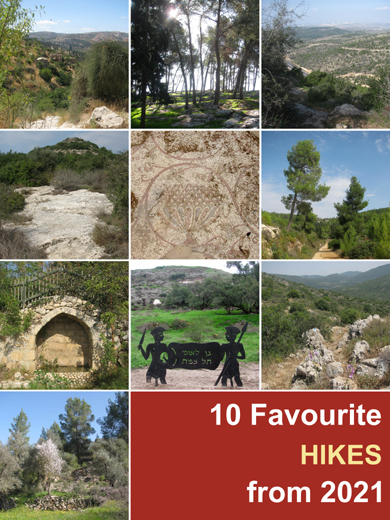
My second review of 2021 covers my top 10 favourite places that I visited during the last year. There were actually too many places to decide on just 10 this year, so I split my top 10s into two. You will find my top 10 favourite places but also my top 10 favourite hikes. Mister Handmade in Israel and I really made the most of our limited ability to travel further afield this year and have continued getting to know the area around us, exploring the hills and lowlands around Jerusalem and beyond.
We started off the year visiting the Tzuba Spring and Belmont Fortress, the remains of a Crusader period fortress in the Jerusalem Hills. Another hike in the Jerusalem Hills, along Nahal Sorek, was one of the hardest hikes we did, though it was also an extremely beautiful one and perhaps the most satisfying. We visited Tel Tzafit, thought to be the site of the ancient Philistine city of Gath, and walked the historic Burma Road, an unpaved road built during Israel's War of Independence. The road was built in order to bypass Jordanian forces and to renew supplies of water, food and equipment to the Jewish community in Jerusalem.
We got lost in the Tzora Forest and saw beautiful spring flowers around Ein Kerem. I have driven past the remains of the Arab village of Lifta hundreds of time in the almost 27 years that I have lived in Israel but never knew the ruins were there! Hidden down below the road in a steep valley, it was wonderful to explore the old buildings and take some magical photos!
Basically, I have discovered a real passion for gentle hikes around my little country. I was once hesitant to hike without a guide but now we regularly pull on our walking boots and set off on a new route. I am loving it! I tell Mister Handmade in Israel that he should appreciate that I am happier with a flask of coffee and a sandwich in the hills, rather than an expensive restaurant or a spa.
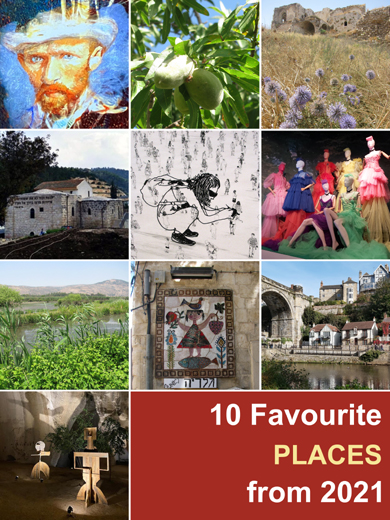

Now, having said how much I enjoy hiking, I also love going to exhibitions and seeing new places. In 2020 I only managed to get to one indoor exhibition, POP-UP Museum TLV 2, a graffiti event in an old apartment building in central Tel Aviv. In 2021 I was able to see more, though we still go masked up, to protect myself and others at risk, and have to show our Tav Yarok (Green Pass), proving that we have been vaccinated or recovered from Covid-19 in order to gain entry.
In 2021 I saw the wonderful "Van Gogh: The Immersive Experience" at Peres Park in Holon. I particularly enjoyed the virtual reality tour, where we were guided through a virtual, colourful depiction of Van Gogh's life. In June Mister Handmade in Israel and I went to see the Italian artist Ivo Bisignano's "Human Forms" exhibition in a cave at Beit Guvrin. In July I made a return visit to the Tel Aviv Museum of Art to see Zadok Ben-David's incredible installation, "People I Saw but Never Met" and was delighted by the amazing "The Ball" at the Design Museum of Holon.
But the best thing I did in 2021? I finally got on a plane and visited the UK to see my niece get married and to spend time with my dad! We had a wonderful time together.
I have blogged about all of these amazing places and more. Please click on the names above and enjoy exploring Israel (and a teeny tiny bit of the UK) with me!


Monday, 4 January 2021

The Best of 2020 - Part II


1. POP-UP Museum TLV 2  2. Gazelle Valley 3. Beit She'an National Park 4. The Argaman Iris Reserve 5. Celebrating My 50th Birthday in the Middle of a Pandemic 6. Nahal Arugot 7. Latrun Fortress 8. The Masrek Nature Reserve  9. The Scroll of Fire and Anne Frank Memorials 10. Shvil HaErez (The Cedar Trail)

Happy New Year! I am going to start the year with my second review of 2020, my top 10 favourite places that I visited last year.
When I started writing this blog back in 2008 I initially kept it as a blog purely about my papercut art. However, I soon found out that people were interested in reading a little more about me and my life here in Israel. I started to write blog posts about my Jewish faith and many of the holidays we celebrate and about some of the beautiful places I have been fortunate to visit in Israel.
This month I will be marking 26 years living here. Over the years I have enjoyed exploring my little country, from north to south, indoors and out. Of course 2020 was like no other year. We have been in lockdown three times and were barely able to leave the house. Foreign travel was impossible, though back in February I was fortunate to spend a lovely couple of weeks with my dad in the UK, before all the coronavirus troubles really began.
Having said all that, Mister Handmade in Israel and I have made the most of it and have really got to know the area around us. From the summer onward, we hiked almost weekly, rarely driving more than 40 minutes from the city where we live. We have discovered some beautiful areas and some amazing history. I was once hesitant to hike without a guide but now we regularly pull on our walking boots and set off on a new route. I'm not saying we never get lost - of course we do - but that has been part of the fun and there have been no major disasters!

As you can see from my Top 10, the year started off with just one "indoor" visit, to the amazing "Pop-Up Museum TLV" graffiti event in Tel Aviv. Also in January, we spent a lovely day in Beit She'an with friends visiting from Cyprus. After that, everything has been about just the two of us exploring the hills and forests around us. I celebrated my 50th birthday in a national park just outside Jerusalem and in June we travelled further afield to the Dead Sea area, to spend Mister Handmade in Israel's birthday hiking at Nahal Arugot. I have blogged about many of these amazing places and more. Please click on the names above and enjoy exploring Israel with me!


Monday, 13 July 2020

Nahal Arugot

You may remember that back in May, when I celebrated my 50th birthday, we planned to go hiking in Ein Gedi, the biggest oasis in Israel. Well, it turned out to be too hot that week but Mister Handmade in Israel suggested that we go on his birthday instead. June actually felt cooler than May this year, so when his big day came around, off to Ein Gedi we went!
There are two major nature reserve hikes in the Ein Gedi area. Nahal David and Nahal or Wadi Arugot. Nahal Arugot seems to attract less visitors, which can be advantageous during a pandemic, so we set off very early on Mister Handmade in Israel's birthday and were at the Dead Sea, the lowest place on earth, by 8am!
Nahal Arugot is one of the few canyons in the Judaean desert with water all year round. It has a number of springs that provide water throughout the entire year. It is also the longest running river on the western coast of the Dead Sea and flows into the Dead Sea, passing through Ein Gedi. The water is fresh and very drinkable (there is a free of charge cooler for filling up any half empty water bottles next to the ticket office). Kibbutz Ein Gedi, on the hill to the south of the river mouth, uses the water for its own consumption but also markets it as a bottled mineral water.
The Hebrew name Nahal Arugot means "flower beds". It is based on the Arabic Wadi Araja, "the ascending brook". This area is where David hid from the pursuing King Saul (1 Samuel 23 29: "And David went up from thence, and dwelt in strong holds at Engedi"). Nahal Arugot was also one of the sources of water to the ancient site of Ein Gedi, which dates back to the Chalcolithic period (approximately 5,000 years ago).
There are two paths to choose between at Nahal Arugot - a dry hike on the river banks, overlooking the river from a high steep cliff, or a walk in the water. We chose to walk in the water, which turned out to be a little harder than we expected since it includes some climbs against running water and river crosses with slippery stepping stones. It also took us longer than the 1 hour each way that we had been advised, but the scenery was beautiful and there was a lot to see and enjoy.  
Due to the fresh water and the high temperatures of the region there is vegetation such as oleander, Capparis, Calotropis Procera (the poisonous Apple of Sodom) and saltbush in the valley. There are also a lot of tamarisk trees. These are evergreens with small scale-shaped leaves. They blossom during the summer with a white-pink flower. These trees were frequently planted by the Jewish National Fund in arid conditions for shade - in the Negev, in the Jordan Valley and by the Dead Sea - but the trees at Nahal Arugot are natural. Most botanists and bible scholars believe that the Eshel tree planted by Abraham in the Book of Genesis, was Tamarix aphylla; "And Abraham planted a tamarisk tree in Beersheba ..."
There are also many acacia trees. The Acacia raddiana is a thorny tree that has a single trunk and round branches and is the most common acacia in Israel. It grows in the Negev, the Arava and Judaean desert. The Acacia tortilis is a another thorny acacia tree with a number of trunks. It is easy to recognise because of its multiple trunks and umbrella shape. This tree also grows in the Arava Valley and on the Dead Sea shore up to Ein Gedi.
The path, which alters between wet and dry, leads all visitors to The Hidden Waterfall ("Mapal Nistar"), above. It is the highlight of the hike! We started to wonder if we had walked right past it, since the hike had taken us longer than an hour, but once we saw the pool and waterfall at the end of the lower path, we knew that we were in the right place. It was a beautiful sight and a wonderful way to cool down! I stood under the pounding water for a natural massage. (Yes, I have a photo of it. No, I am not posting it here!). There is another pool and waterfall higher up but it was recommended to only walk as far as this waterfall in the summer heat and, truthfully, it was enough for us.
Just as a matter of information, the waterfall is one of only two places on the route where eating is allowed and it was the perfect spot for a lunch break.
I was excited to see Nubian ibex, below, as we hiked back to the starting point. They roam around the cliffs and steep slopes which are its natural habitat. At one time the ibex almost became extinct but were rescued thanks to stricter enforcement of the nature reserve laws and strict prohibition on hunting. One might also see rock hyrax, Golden spiny mouse, porcupine, river crabs, Agama Lizards, striped hyena and more. The most exciting would be footprints of the single Arabian leopard (Panthera pardus nimr) that once survived at Ein Gedi, though the last time it was spotted was 2007. The species is now presumed to be extinct here.
We had originally intended to take the dry path back from the waterfall to our car, to enjoy the spectacular views and dry off, but the stream and shallow pools were once again irresistible. We were soon splashing in the water and an hour or so later were back at the trail head. We had hiked a distance of about 7 km and spent around 5 hours in the canyon.
Nahal Arugot had proved to be an amazingly beautiful hike and it was just about the right time of the year to do it. Any later would have been too hot. The hike is apparently lovely during the winter months and if you happen to be there at the right time, you get to see some beautiful flowers like the desert tulip and other rare species. I'll definitely be going back!

Thursday, 25 October 2018

Avdat National Park

The day after our hike in Ein Avdat we took ourselves off to Avdat National Park. Ein Avdat and Avdat National Parks are located close to each other in the Negev desert. Ein Avdat National Park offers a hike in the desert canyons, while in Avdat National Park you can see the remains of a Nabatean city.
Avdat, also known as Abdah, Ovdat and Obodat, was a city on the Incense route, the route by which incense, perfumes and spices were brought from Arabia through the Negev and to the port of Gaza. Like Mamshit it was inhabited by the Nabateans, Romans and Byzantines between the 1st century BCE and the 7th century CE. The city was named for the Nabatean King Oboda II (1st century BCE) who developed the city; he was revered as a god, and was buried in the city. Avdat was destroyed by an earthquake in 630 CE, and shortly after, in 636 CE, the area was conquered by Arab tribes. These two factors together sealed its fate and the city was abandoned. Modern archaeological study of the city began in the 19th century, and in 1870 a researcher by the name of Palmer identified the site and determined that it was the city of Avdat. Excavations began in 1958.
Avdat was declared a World Heritage Site by UNESCO in June 2005 but on 4th October 2009 the site suffered extensive damage when hundreds of artifacts were smashed and paint smeared on walls and an ancient wine press. In a lengthy rehabilitation project, the damaged artifacts were restored and the security arrangements at the site were reinforced. Avdat was also the filming location of the 1973 film Jesus Christ Superstar.
We started our visit to Avdat at the entrance to the national park. There we found an information centre with displays about the Incense route, antiquities from the site and a short film about the Incense route and how the Nabateans water harvested to survive in the desert.
We left the museum and drove to the upper parking, stopping en route to explore the store caves in the lower city, above. The caves were used as tombs during the period of the Nabatean settlement, while the Byzantines used them for dwellings, stables and monasteries, as well as for storing agricultural produce and fermenting wine.
At the top of the hill is the main city of Avdat. At the entrance to the city is a Roman tower with an inscription dating back to the late 3rd century; the Roman tower was built by a local Nabatean architect who was so skilled that the lower story and roof survived the 630 CE earthquake. This tower is the oldest Nabatean building found in Israel.
From the tower we continued on to the street in the Byzantine quarter. The main street had homes on each side; it was destroyed in the earthquake but the arches of the "vaulted room" were reconstructed during the conservation project after vandals tore them down in 2009. The drainage system collected rainwater from under the streets and drained it into cisterns.
A huge Roman army camp was well preserved, as was the Byzantine wine press, with its crushing floor and the large collection hole in a second room. It was part of a Late Roman/Early Byzantine farmhouse. The Byzantine citadel with its tower, large water cistern and channel through which rainwater flowed, is also well preserved. The view from the tower was spectacular!
The remains of an old Nabatean temple is located in a large hall, which is flanked by two churches. The Southern church was part of a monastery, named after Saint Theodore, a Greek martyr of the 4th century. The Northern church is the older church, which was built from the stones of an earlier pagan temple. 
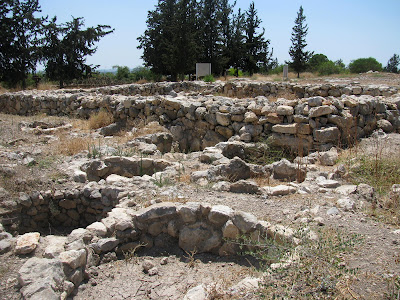
Returning to our car we drove back down the hill, stopping first at the remains of a Roman villa which was built alone, overlooking the agricultural land and the Zin Valley. The villa is built around a square central courtyard with a water cistern in the centre. We then made another stop further down the hill at a burial cave which dates from the 3rd century CE. It contains 20 hewn burial niches and engravings of the sun and moon. The burial cave is thought to be a shrine to Aphrodite.
Finally we went to see the bathhouse at the bottom of the hill, which was built in the 4th century by Roman soldiers. Though it was locked and we were unable to go in, we learnt that it had two hot rooms, a cool room, a warm room, and a dressing room. An adjacent well, 70 metres deep, contained water that flowed through a channel to the bathhouse.
Avdat is one of the best preserved Nabatean cities in Israel. It was a great place to learn about the Nabateans, and the Romans and then Byzantines who inhabited this spot. The reconstructed rooms, churches and temple were impressive, but it was the gorgeous views from the top of the hill that left the biggest impression. Exploring this site is a must for anyone trying to grasp the history of the Negev desert and its people.

* This post has been shared on Travel Tuesday, Wordless Wednesday (on Tuesday), Wednesday around the World, Little Things Thursday, Thankful Thursday, Friday Foto Friends and All Seasons.
Oregon Girl Around the World
Travel Notes & Beyond