Sunday, 9 September 2018

The Blue-Arsed Fly

My customer knew exactly what she wanted on the card for her "Cracking Husband". She asked me to show him standing on a three-level medal podium. On the number 2 level she wanted me to show a chicken with no head (there's a first time for everything!). On the number 3 she wanted a blue-arsed fly (another first!). Her husband was to appear in the middle with 3 gold medals around his neck - one saying Son, one Husband and one Daddy.
I had to work on a very small scale to fit such tiny details on to this card but I am pleased to say that my customer loved it.
"Thank you for the card...it came out so well and S. loved it!" she wrote to me. "He knew what it all meant straight away and really laughed."
I must admit that I was chuckling to myself when I made that little blue-arsed fly!
Yonatan turned 15 some time ago. His mum asked me to create a card showing him playing on his PlayStation. He is also a big football fan, so I added a football and the symbol of the 2018 FIFA World Cup, the big football tournament happening over his birthday. Yonatan also loves to travel. I included a picture of Big Ben on his card, along with "A Windmill In Old Amsterdam" and an aeroplane. A big number 15 marks his age.
This evening my family and I will begin celebrating the two-day holiday of Rosh Hashanah, the Jewish New Year. Rosh Hashanah is the first of the High Holidays, the most solemn days of the Jewish year, which conclude with the holiday of Yom Kippur, the Day of Atonement.
I would like to wish all my Jewish customers and friends a very happy, healthy and successful new year - 'Shana Tova U’Metuka' ("May you have a happy and sweet year").
To read more about Rosh Hashanah, please check out my various posts about the holiday.

Thursday, 6 September 2018

Lucy's Album

Lucy celebrated her Bat Chayil back in July and her aunt and uncle asked me to create an album for her special weekend. (Bat Chayil means 'daughter of valour' and is an Orthodox Jewish ceremony. It takes place in Orthodox synagogues at a date close to the girl's 12th birthday. The girl will give a talk on a Jewish topic, but not during the Sabbath service.)
Lucy is an actress and singer (she was in Chitty Chitty Bang Bang in the West End) and she loves maths and science at school. Her favourite food is sushi and edamame beans, and she also loves ballet and pointe work. Her mum told me that her daughter's favourite colour is pink and that the colour scheme for her Bat Chayil celebration was going to be hot pink.
I have shown blonde-haired Lucy with a microphone in one hand. Behind her are two big spotlights. To her right is the Chitty Chitty Bang Bang logo, the show she was in for a year, and some sushi and edamame beans. On her left are some music notes, some pointe ballet shoes and two books with Science and Maths printed on their spines.
Lucy's Bat Chayil appears at the top. The date of her Bat Chayil celebration is below. The silver lettering and pink background box match the colours of her celebration perfectly, while two silver Magen David's (Star of David) appear in two corners of the cover, surrounded by shades of pink to match the colour scheme as well.
I also decorated five pages inside the album. The first page, the opening page, has a microphone and some music notes on it. Next I added another spotlight and the Chitty Chitty Bang Bang logo, followed by a page with two books on it, illustrating Lucy's favourite subjects at school. I created some teeny tiny sushi and edamame beans for the following page in her book and, finally, for the last page I crafted some more pale pink pointe shoes.
Lucy's mum was very enthusiastic about the album. "That front cover looks just fantastic - you really have captured Lucy." she wrote to me, then followed it up to say that "She [Lucy] loved it - so special. Thank you."

Monday, 3 September 2018

"Rock Paper Scissors" at the Tower of David Museum

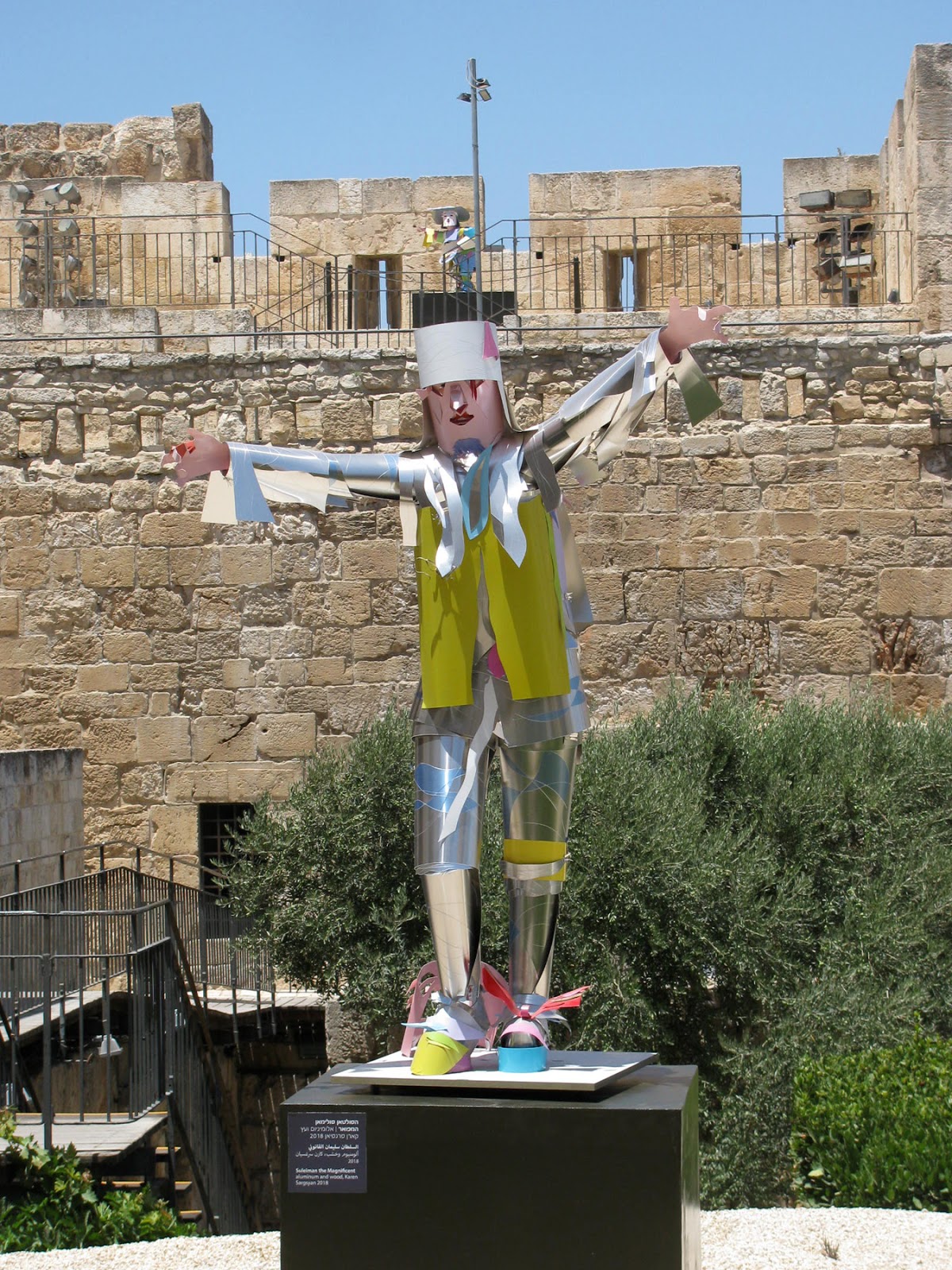
It's been a busy summer and I have a lot to show you, starting with a wonderful exhibition I visited back in July at the Tower of David Museum in Jerusalem's Old City. The exhibition "Rock Paper Scissors" presents the work of Karen Sargsyan who was born in Yerevan, capital of Armenia, in 1973. He studied martial arts at a sports college, excelling in boxing, and was a professional boxer for seven years. During his sport studies Sargsyan took anatomy courses. The workings of the body, muscles and joints fascinated him and the results can now be seen in his sculptures.
Owing to the unstable political and economic situation in Armenia, Sargsyan moved with his family to the Netherlands in 1998 where he began working in drawing and sculpture and was accepted to the prestigious Rijksakademie in Amsterdam. Sargsyan is regarded as one of the leading paper artists in the world. His works have been displayed in museums worldwide, including the Tate Modern in London and the Centre Pompidou in Metz.
In the Tower of David Museum exhibition Sargsyan uses the stories, legends, myths and history of Jerusalem as a basis for his sculptures, bringing several personalities from the long history of the city "to life". Nine spectacular figures, all of whom at some point in history had influence over the city of Jerusalem, can be seen within the museum's archaeological garden and citadel. These range from King David, King Solomon and the Queen of Sheba, to Cyrus of Persia, Herod the Great, Queen Melisende and Suleiman the Magnificent, as well as the more modern public figures of Anna Ticho and Eliezer Ben Yehuda. (Unfortunately the figure of Ben Yehuda had been removed on the day I visited.) 
The exhibition posed a new challenge for Sargsyan. Though most of his work has been using paper, for the first time he was presenting his works outdoors, so he had to find materials which would survive the weather. Additionally, the material had to yield to his knife with a similar flexibility to paper. These two considerations led the artist to create almost all of the figures in the exhibition using very thin sheets of coloured aluminium, cutting them either before or during his work. He used over 100 kilogrammes of aluminium sheets and 2,500 knives, all of which he transported from Amsterdam to his makeshift studio in Israel.
Sargsyan created each of these sculptures without sketching the figure beforehand. His creative process is spontaneous and relies on very little planning, though he does use a wooden frame as a general outline for his works and the face mask is common to all his figures. For the most part, however, he relies on intuition to produce his multi-layered sculptures, which are full of depth and humour and often seem as if at any moment they will burst out of their paper shell and spring to life.
The Tower of David, also known as the Jerusalem Citadel, is an ancient citadel located near the Jaffa Gate entrance of the Old City of Jerusalem. The citadel that stands today dates to the Mamluk and Ottoman periods. It was built on the site of a series of earlier ancient fortifications of the Hasmonean, Herodian-era, Byzantine and Early Muslim periods, after being destroyed repeatedly during the last decades of Crusader presence in the Holy Land. It contains important archaeological finds dating back over 2,000 years including a quarry dated to the First Temple period, and provides some of the best 360-degree views across the Old City and Modern City. It is also a popular venue for concerts and sound-and-light performances. Some readers of this blog may remember the Koolulam social-musical initiative in which I participated back in June, which took place within the grounds of the ancient citadel.
The name "Tower of David" is due to Byzantine Christians who believed the site to be the palace of King David. They borrowed the name "Tower of David" from the Song of Songs, attributed to Solomon, King David's son.
Whilst it was the "Rock Paper Scissors" exhibition that drew me to the Tower of David Museum, I was fortunate to find another interesting exhibition, "London in Jerusalem", on at the same time.
On 11th December 1917, on the steps of the Tower of David, General Allenby proclaimed British rule and in 1922 the British implemented the Mandate established by the League of Nations. British rule over Jerusalem lasted thirty years, a mere moment in the 3,000 year history of the city. However, in this brief moment, Jerusalem was dramatically changed. When the British took over Jerusalem they found a very poor city, rampant with cholera and no sewage system or electrical lighting to speak of. Governor Ronald Storrs took over the leadership of Jerusalem and brought orderliness and culture to the life of its residents.
The exhibition "London in Jerusalem" examines the extensive cultural activity that the British, Arabs and Jews took part in during the British rule, exploring the music, past-times, drinks, news and cinema of the period. 
Jerusalem became the place for extensive social activity. Choirs were formed, as well as dance troupes and theatres, coffee houses and cinemas, private salons and public cultural events, football pitches and universities. New initiatives were established which boosted the economy and culture of Jerusalem.
The Tower of David exhibition has recreated a Mandate-era cinema, radio entertainment from the 30s and 40s, soirées in the living room and Fink’s Bar. If there was one place that held the secrets of Jerusalem during this time period, it was Fink’s Bar, below. It was here that British officers and locals brushed shoulders, where Jewish resistance fighters and English gentleman would share the bar. In the centre of the exhibition are tables and chairs that one might have found in the many tea houses that started springing up around the city.
The "London in Jerusalem" exhibition highlights the amazing cultural life in Jerusalem under the British Mandate, turning away from the political, religious and symbolic aspects of Jerusalem that usually occupy our attention. For this Brit living in Israel, it was a wonderful way to end my visit to the Tower of David Museum on a hot and sunny July day.