Tuesday, 6 June 2023

The Exhibition I Wasn’t Ready to See

All photos by Ingrid Muller

In May we put together an exhibition of our son Gadi's drawings in a local gallery space, to mark the year since his passing. While Gadi created some wonderfully detailed artwork over the years, we never expected to be putting together a show of his art for a long time to come. It was something that I hoped - no, believed - would happen one day in the future. The events of 21st May 2022 changed all that and when a friend, curator Shira Friedman, approached us with the idea of putting together an exhibition of Gadi's work, we thought it was the perfect way to remember Gadi and to share his talent.
Gadi loved to draw. He would spend hours in his room creating highly detailed pieces based on his passions at the time. He drew football players and knights, animals and steampunk characters, mythical islands and maps. There was a long period when he drew football stadium after football stadium, concentrating not on the pitch but on the crowd. These stadiums are not the stadiums that Gadi visited in his short life. We can’t see Ironi Modi’in’s stadium, nor Hull City’s. He didn’t draw Camp Nou, which we toured back in 2017, or the Emirates. These are the stadiums of Gadi’s imagination, filled with animated crowds waving flags and banners and setting off flares. He drew each piece in great detail, using an extra fine pen to add each and every member of the crowd and to include even the wording on their banners.
Football stadiums aside, Gadi’s work was almost always in black and white. Though he had drawers full of felt tip pens and coloured pencils, he preferred a simple graphite pencil and, later a super fine black pen. His early drawings are sweet and simple but with a strong use of line to define his shapes and figures. His later pieces are small in scale but full of detail.
Gadi was not precious about his work. He was proud to show us his drawings when he was satisfied with them but many, many pieces ended up in the rubbish bin as well. The reason we were able to hold this exhibition was because I carefully saved what I felt were the best of them when tidying up Gadi’s incredibly messy room! Aviv, Gadi’s best friend, did the same when Gadi would leave his drawings lying around at school.
Gadi was still drawing when he was in the IDF (Israel Defence Forces). His sketchbook was found in his tank. He had told friends that he wanted to make better use of the many spare hours he had, when he found himself sitting around doing very little.
Gadi was also a brilliant writer. His short stories, written from the age of six and upwards, were very, very funny. Characters such as Felinius the Genius and Mister Bakewell Tart were so very English that it was hard to believe they had been thought up by a young boy living in Israel! I don’t remember ever having made a Bakewell Tart in my life, but Gadi was a voracious reader and probably learnt all about them from a book. As he got older, he wrote less, but the stories remain as amusing as the day he penned them.
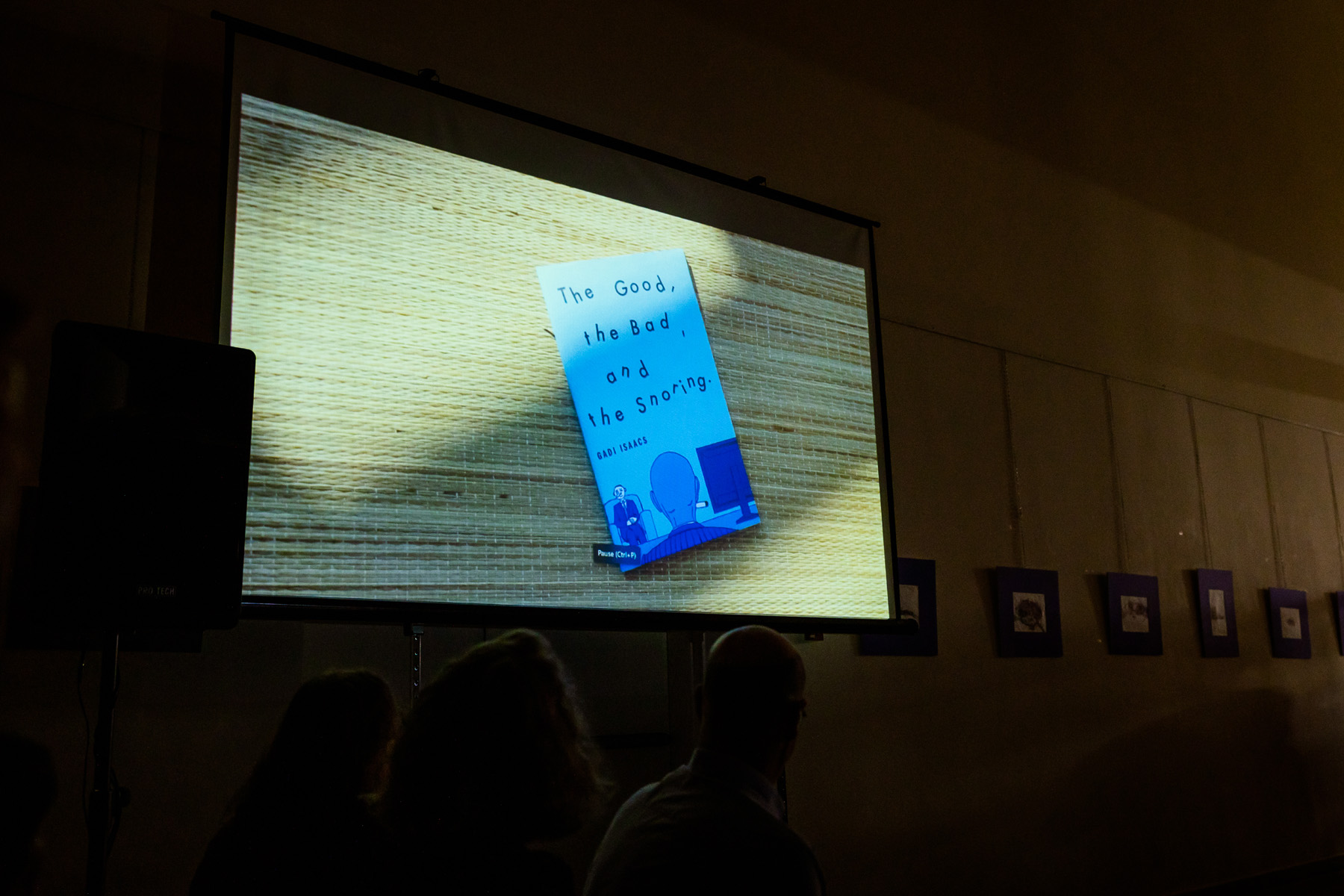
A particular favourite of ours was a long story he wrote for Mister Handmade in Israel's 50th birthday back in 2014. In fact, the name we gave to the exhibition, "The Good, the Bad and the Snoring", was the name 11 year old Gadi gave to the story. With the help of Mister Handmade in Israel's brother and his amazingly talented friends and colleagues in the UK, this story was made into a wonderful short film which we showed on the opening night of the exhibition.
I have posted it below for you to enjoy too.
The exhibition was visited by hundreds of our friends and many others who had heard or read of Gadi's story in The Jerusalem Post,  Israel's most-read English newspaper. The mayor of Modi'in-Maccabim-Re'ut came, as did senior members of the IDF and many of Gadi's soldier friends. The opening night - after months and months of planning - was somewhat stressful because four hours before the exhibition was due to open, missiles started coming over from Gaza. We decided to go ahead with the evening anyway, posting on social media where there were protected spaces if needed!
I am sure that Gadi would have been very proud of the exhibition and happy that so many people were able to see his work. I only wish he had been there to enjoy it for himself.


* This post has been shared on My Corner of the World and Wordless Wednesday (on Tuesday).
Sticky Mud and Belly Laughs

Thursday, 19 January 2023

19 Years of Mum's Birthday Cards

I was saving this post for my youngest son's 21st, just as I did for his older brother back in December 2021, but it wasn't meant to be. Little did I know that he would not reach 21, nor even 20. It is impossible to believe that my cards stop at 19.
Gadi died on 21st May 2022. You can read his story here. 19th January 2023 would have been his 20th birthday. Instead of making him a special card and a yummy cake, we have invited his friends and fellow soldiers to join us for a barbeque, to remember Gadi and share stories about him.
Now I will tell you all about Gadi through the cards I made him every single year of his short life. I am so happy that I carefully saved them all.
Age 1. Gadi's 1st birthday card showed a little bear holding a balloon. The bear is sitting on a block with a big number 1 on it.
Age 2. This year a big smiley lion with a beautiful red mane went on Gadi's card.
Age 3. Gadi had developed an interest in pirates. He loved dressing up in his Early Learning Centre pirate costume, so I showed a pirate with a red spotted bandana. Next to him is a skull and crossbones flag or Jolly Roger. I added an island and palm tree and X marks the spot indicating where the pirate treasure is buried.
Age 4. This year Gadi was into knights and dragons. This rather sweet looking knight is holding a large shield and sword. The fiery red dragon looks a little scary.
Age 5. It looks like Gadi was still into pirates - or perhaps highwaymen - and swords, but he was also developing an interest in animals. We once visited a hedgehog hospital in the UK, so perhaps that is why I added one to his 5th birthday card. 
Age 6. I wrote in my blog post that Gadi had been checking for weeks that I had made his 6th birthday card and that he told me exactly what should be on the card. He wanted me to show him wearing his Dracula dressing up costume, with a bat on his shoulder. Gadi was into all things scary.
Age 7. Gadi had great plans when he was 7. He wanted to be a scientist when he grew up. Not only a scientist, but a scientist who travelled to the moon and deep down under the sea, thus the spaceman and his rocket and a diver and fierce shark. He was an avid reader, loved to draw and was fascinated with the scary things in life. I added a couple of bats and a mummy to the design. He also loves the animated series Ben 10, so I showed him wearing a Ben 10 shirt and holding some 'scientific potions'.
Age 8. Football has always been THE sport in our house but at 8, Gadi had his own ideas and was passionate about the Korean martial art of Tae Kwon Do. He had a yellow belt with two very important stripes on it and the design on his birthday card showed him in action, wearing his white suit and the aforementioned belt. He was still a big reader and still loved to draw. The very scary looking 'Weeping Angel' in the top right hand corner of his card had to be included because of his interest in the science-fiction series Doctor Who. 'Mocca' the toy guinea pig popped in too!
Age 9. Gadi was very creative. He loved to draw and wrote some great short stories. But with the creativeness came messiness and there wasn't a pencil in his room which had not been gnawed. For his 9th birthday card I showed him wearing his favourite "leather" jacket, with his bullet necklace round his neck, a book in one hand and the aforementioned chewed pencil in the other. In front of him is one of his Doctor Who drawings. Cookie the hamster is perched on top of the number 9. Finally I added some coloured Lego blocks - another favourite activity - and a big pile of books.
Age 10. When Gadi turned 10 I decided to show him surrounded by his books. He would leave them all around the house and would often simply start reading a book if there happened to be one near to where he was sitting.  He has paper and pencils in front of him too, since he still loved to draw.
I also showed him barefooted on the card. Gadi was always dressed for the summer. He never seemed to feel the cold. He wore a t-shirt when it was pouring with rain and would remove his socks the minute he got home, to walk barefooted on our cold tiled floors.
His other main interest at the age of 10 was maps. He had great plans to travel the world. The National Geographic map I have shown on his card is still on the wall above his bed.
Age 11. This year was the year of the Nerf Gun. I showed my now 11 year old with his new Nerf in his hands. Little blue and orange Nerf darts are scattered around him and there is a big pile of books in the background. Gadi was still a huge reader. His drawing of a Komondor dog - or as he called it, "The Mop" - is on top of the pile of paper in front of him. A couple of pencils are lying around too.
Age 12. Gadi always really wanted a dog, so I showed him hugging one. Behind him is his new scooter.  A pile of books had to feature on the card, as did the obligatory pencils and Nerf bullets as well. Gadi was now practising Krav Maga and is dressed in his blue Krav Maga trousers and white t-shirt. He is barefooted, as he was when practising Krav Maga, but then he was almost always barefooted anyway!
Age 13. This year's card, like last years, had to be about dogs. Every day Gadi would remind us all just how much he wanted a dog. He showed us pictures of them on his phone and we would watch clips together from The Daily Puppy online. At meal times he would shuffle in his chair, "I want a dog. Let's get a dog".
I wish we had got him one.
Age 14. Gadi was obsessed with his laptop, but when I did manage to peel him off it, he was still the artistic, creative, bookworm that we loved. Once again books had to feature on his birthday card, though by this age you'd find him with a Kindle in his hand instead. His phone, laptop and headphones had to appear too, along with some pens and a pencil. He still loved to draw. New additions this year were his skinny jeans and hair gel. He used to get his hair cut more often than anyone else in the family and then spend ages styling it in front of the mirror! Finally I added a little short-legged dachshund, which was his favourite breed of dog at the time. 
Age 15. Gadi's favourite dog this year was the Golden Retriever, so that's what I put on his card. He has his Xiaomi phone in one hand and behind him is his laptop computer with one of his favourite Instagram pages, The Daily Woof, open on the screen. I also added some sushi, his Kindle and the badges of his two favourite football teams, Ironi Modi'in and Hull City. Football had begun to take over.
Age 16. When Gadi turned 16 I showed him holding an Israeli drivers L-plate in one hand and in his other hand he is holding his grey MUN folder. MUN, or Model United Nations, is an academic activity in which students can learn about diplomacy, international relations, and the United Nations. Gadi, though a bright kid, was not the most serious of students, but he really enjoyed the MUN conferences. He was even willing to dress the part and would put on a white shirt and tie for the occasion! In fact, his school has renamed their conference the YachadMUN 2023 in Memory of Gadi Isaacs. A big honour. 
Once again I included the team crests of Gadi's favourite football teams, Ironi Modi'in and Hull City, along with a football. His Xiaomi phone had to appear on the card as well, along with his Kindle and some pencils to represent the hours he spent drawing in his bedroom.
Finally, he had almost given up on asking us to get him a dog and had reverted to begging for a hamster, the pet we used to have when the boys were younger. You can see a tiny little hamster peeking out from under the Israeli L-plate.
Age 17. Gadi's 17th birthday card yet again featured dogs. He used to walk several of the neighbourhood dogs, two of his regular clients being a couple of very cute dachshunds. He often brought them round to our home for me to see them too and one of them left me a 'present' which you can see on his card! It certainly made Gadi laugh when he opened it.
When Gadi went to visit grandpa in the UK in the summer of 2019, he returned home with a Hull City jacket which then rarely came off his back. I showed him wearing the much loved jacket on his card, along with his black adidas sweatpants and the Blundstone boots that all the Israeli kids wear. The blue t-shirt was a nod towards our local football team, Ironi Modi'in. He had a guinea pig in his hand. He was still desperate for a pet.
Age 18. Gadi turned 18 when Israel was in its third lockdown and it certainly wasn't the 18th birthday he had dreamt of. He had to make do with celebrating his special birthday at home with mum and dad. The dog that appeared on his birthday card is Tofu, our neighbours' dog, who Gadi walked daily. Those two loved each other.
Gadi had passed his driving test since his last birthday and, when we were not in lockdown, liked to take dad's car out for a spin with his friends. I showed the car on his card. He is proudly pointing to the car keys. I added Ironi Modi'in's badge to his card as well. Gadi could now legally enjoy a beer with his friends, so I included an overflowing beer glass, along with his precious phone, which never left his hand.
Age 19. Gadi spent his very last birthday in the company of the Israel Defence Forces (IDF). He had enlisted back in August and was a tank driver. I showed him with short hair on his birthday card. The army required him to keep his curls short. He is holding his rifle and there is a tank behind him. I also included Ironi Modi'in's badge. Even though he was somewhat preoccupied, Gadi still managed to keep an eye on what they were doing and went to an occasional game too. Finally, I showed him against a stunning orange sunset. He had a good eye for photography and had sent us a few great shots of tanks in the desert since his service began.
Gadi loved his card and squirrelled it off to his room to place it on the shelf next to his Giyus Kal (an easy call-up) card. They are both still standing there.

Happy 20th birthday Gadi. I love you and miss you so much.

* This post has been shared on Little Things Thursday
Sticky Mud and Belly Laughs

Wednesday, 21 December 2022

Atlit Castle and Khirbet Karta

The day that we went to see the flamingos in Atlit we also took a walk along the beach to view the ruins of the Crusader fortress Château Pèlerin, also known as Atlit Castle. Built in 1218 by the Templars and taken over by the Mamluks in 1291, it was one of the largest fortresses in the Holy Land. The fortress was built on a promontory, with two main walls cutting the citadel off from the land and a protected harbour on the south side of the promontory. It also had three fresh water wells within its enclosure. 
Château Pèlerin was not demolished by the Mamluks, as was their normal practice after capturing a Crusader fortification. It in fact remained intact for several hundred years, until suffering damage in an earthquake in 1837.
Aaron Aaronsohn (a Jewish agronomist, botanist and head of the NILI espionage group) established an agricultural station at Atlit in 1911. Château Pèlerin became an important observation point used by the NILI spy team in transferring data to the British during World War I. The NILI spies would make contact with the British who would sail by. The British would send a small boat in to shore in the middle of the night to give gold coins to support the Jewish effort and in return would get detailed plans of Turkish movements. These interactions with the British Intelligence played a part in General Allenby's successful defeat of the Turkish army in Israel in 1917.
Today the fortress is an Israeli Navy base and the headquarters of the Shayetet 13 naval commando unit. As a result, it is within a closed military zone and we were only able to view it from the beach.
We were however able to explore the large Crusader cemetery south of the fortress. The cemetery dates from the 12-13th century and has more than 1,700 graves, above and below. Knights, pilgrims, residents and professionals working on the fortress were buried there and some gravestones are decorated with stylized patterns of crosses and icons indicating the status and profession of the deceased.
I read that the best place to view Château Pèlerin was from the viewing terrace at Khirbet Karta, so that was our next stop. We parked in the Limor picnic area, named after a member of the Genio family who founded the salt works in Atlit, and walked up to the viewing point which was once a British Mandatory water tower. The views of the salt ponds full of flamingos and other migrating birds, the Mediterranean Sea and Mount Carmel were wonderful. To the north we could see the ruins of Château Pèlerin and Le Destroit.
Le Destroit was a Crusader fortress which preceded Château Pèlerin. It was built sometime in the 1100s to protect Château Pèlerin and to secure the convoys that traveled along the sea. It was demolished by the Crusaders themselves about a century after its founding. The reason for this was the Crusaders' desire to avoid a Mamluk siege on the tiny fortress, which count not withstand it.
The Crusaders called Le Destroit Districtum and in French Destroit. The Hebrew name, Khirbet Karta, is related to the Hebrew churvan, meaning desolation or a destroyed place. Karta, which is taken from Aramaic and used today in modern Hebrew, means city, which this place does not really seem to have been.
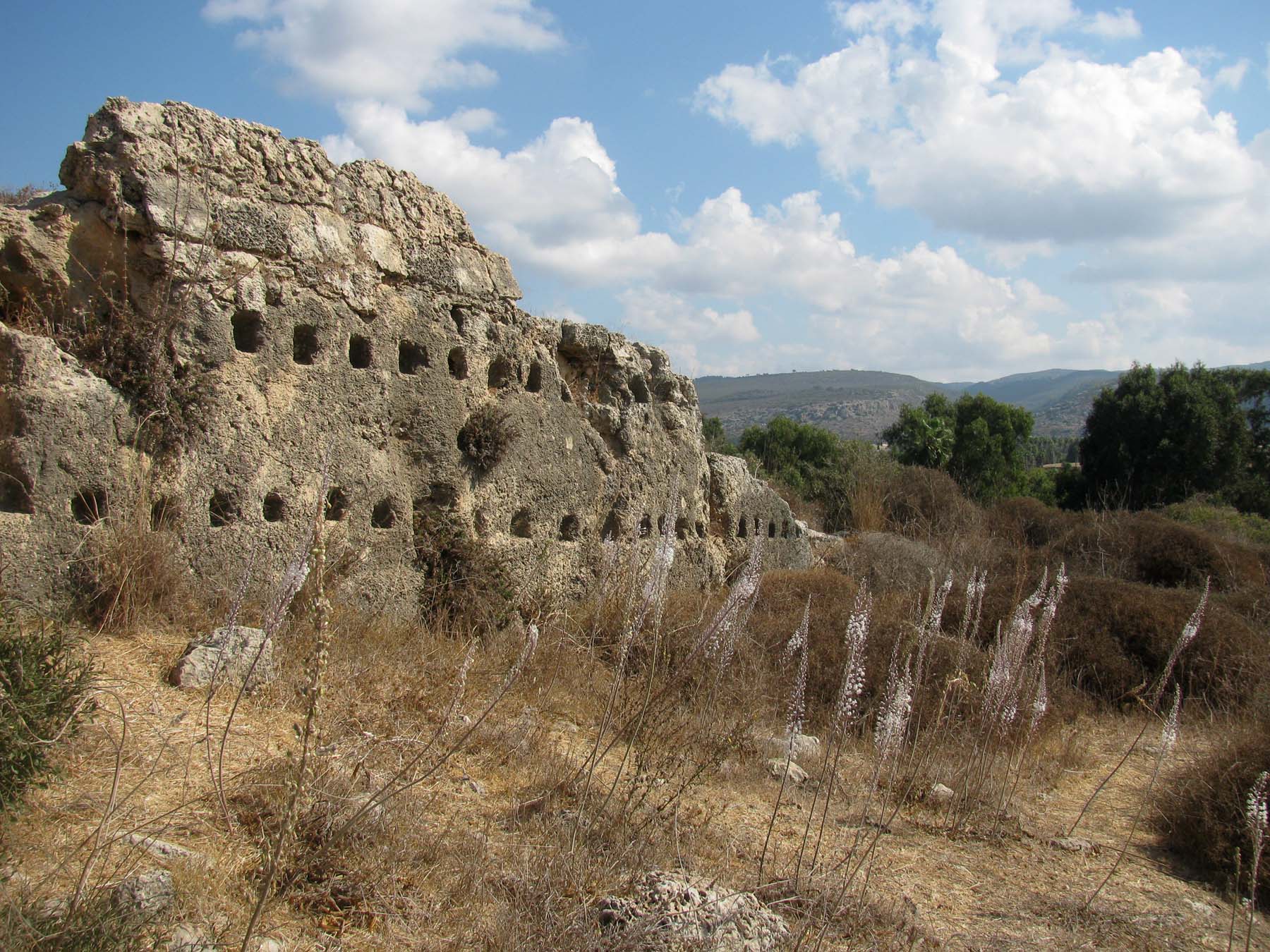
Excavations inside the fortress and the surrounding area revealed water cisterns and the remains of clay pipes used to collect rainwater. To the north of the fortress are the remains of horse stables, below. There is a row of cavities, which were probably used for tying the animals. On the southern side of the stables, there is a row of sockets in the wall that were likely used to support the beams of a wooden roof that covered the place.
Further along we saw a guard booth hewn from sandstone and on the vertical, eastern quarried wall of the fortress, a large ancient inscription which has been cut into the rock. The letters are Phoenician script, probably the first two signs of the name of the Phoenician settlement.
Khirbet Karta is one of those sites that draws large groups of flower lovers every year, to view hundreds of blooming sea squills in one spot. Sea squills bloom at the end of August and September and into October each year, depending on the area and temperature. The blooming occurs earlier in the colder areas and later in the warm places. It just so happened that we visited Khirbet Karta back in October, when the flowers were in full bloom!
The sea squill is a common plant that stands out in the landscape. It is special due to its lifecycle and structure: its onions, its leaves, its flowers and its toxic materials. In November it grows leaves which last through the winter and early spring. By April the leaves wilt and all above-ground parts of the plant die. At the end of the summer a single flowering white pillar without any green leaves rises for just a few weeks. This can grow up to two meters high. The flowering begins from the bottom of the high flower pillar and every day another group of about 30 flowers opens above the previous ones, and the flowers that opened the day before wilt. The flower opens at night and remains open for approximately 18 hours.
The fact that the plant produces leaves in the spring and flowers in the fall is a way to survive the Mediterranean climate because the summers here are so hot and dry.
In Hebrew the sea squill is called Hatzav, from the root meaning "to chisel" because this hardy flower chisels itself into rock. The Jewish sages mentioned that Joshua used the sea squill to mark the borders of the Land of Israel. The plant's toxicity deterred people from digging up the bulbs to move the boundaries. The Egyptians referred to the sea squill as Ein Sit, the god who resists the sun, because it only blooms in the autumn.
The sea squill is one of the rare poisonous plants in Israel and one should not touch the bulbs without wearing gloves. It is related to the onion and, just as onions causes your eyes to burn when you chop them, sea squill leaves contain burning needle-like crystals. The flower was often used to protect graves in Arab cemeteries so that predators like wolves, jackals and hyenas wouldn't dig up the corpses. The flowers are thought of as messengers and are known as basl el maytin (bulb of the dead).
A folk saying across the Middle East and North Africa goes "The sea squill blooms and the summer ends". The sea squill may only bloom for a short period but it is one of the most beloved plants here in Israel. Children are taught to look out for it and the plant even has its own song, כמו חצב, written by Naomi Shemer, one of Israel's leading songwriters.