Thursday, 17 February 2022

Yayoi Kusama: A Retrospective

Yayoi Kusama is widely known as the "Queen of Polka Dots." Born in 1929, she is considered to be one of the most important living artists to come out of Japan. I was recently lucky enough to enjoy a retrospective exhibition of her work at the Tel Aviv Museum of Art. "Yayoi Kusama: A Retrospective" is the first major exhibition to showcase the works of Kusama in Israel, bringing together artworks produced over an eighty year period. More than 200 of her artworks, including sculpture, paintings and installations, are displayed in chronological order, tracing her footsteps from childhood to her career in New York and later in Japan.
Phalli’s Field, 1965.
Women of Shangri-La, 2002.

Kusama grew up in Matsumoto, Japan and trained at the Kyoto City University of Arts in a traditional Japanese painting style called nihonga. She subsequently trained in the yōga style - a form of Japanese painting in a Western style, associated with the rapid modernisation of Japan. She was inspired, however, by American Abstract expressionism and moved to New York in 1958, at the encouragement of the American painter Georgia O’Keeffe. There she became part of the New York avant-garde scene throughout the 1960s, especially in the pop-art movement. She came to public attention when she organised a series of happenings in which naked participants were painted with brightly coloured polka dots. Since the 1970s, Kusama has continued to create art. As she matured and developed, her artworks grew in size and later became the installations and mirrored infinity rooms for which she became famous.
Love Forever, 1966/94.
The exhibition in Tel Aviv begins with two of Kusama's crayon drawings from when she was five and nine years old and already utilising dots in her artworks. It continues through her massive canvases, sculpted works and mirrored infinity rooms, which can only be entered by a few people at a time.
The first infinity room was part of Kusama's phallus phase, a mirrored room filled with soft white protrusions covered with red polka dots. The next infinity room, above, allows viewers to peer through square windows into a revolving kaleidoscope of mirrors and neon lights, something akin to being inside a pinball machine.
The following gallery introduces viewers to Kusama's black polka-dotted yellow painted pumpkins, above, an object that Kusama has viewed as her alter ego and that formed the core of her work after she returned to Japan in 1973. Besides the grand gold pumpkin in the centre of the gallery is her pumpkin infinity room, below, where yellow painted pumpkins are extended by mirrors into an alternative, polka-dotted pumpkin patch.
The Spirits of the Pumpkins Descended into the Heavens, 2015.
The exhibition finishes with two installations created for this Israeli retrospective, "A Bouquet of Love I Saw in the Universe" and "The Eternally Infinite Light of the Universe Illuminating the Quest for Truth", a mirror-lined infinity room with LED lights that slowly change colour, reflected in dozens of mirrored balls set on the floor of the room.
Strolling between the large black polka-dotted pink inflatable tentacles of "A Bouquet of Love I Saw in the Universe" felt rather like being in a large-scale amusement park designed just for adults! People were taking selfies and filming videos amongst the endless patterns of dots. Unsurprisingly Kusama is the most tagged artist on social media, with Katy Perry, Adele and Nicole Richie all seeking out one of her famous mirrored infinity rooms for a selfie. 
A Bouquet of Love I Saw in the Universe, 2021.
Kusama tells the story of how when she was a little girl she had a hallucination that freaked her out. She was in a field of flowers when they all started talking to her. The heads of flowers were like dots that went on as far as she could see, and she felt as if she was disappearing into this field of endless dots. This weird experience influenced most of her later works. By adding marks and dots to her paintings, drawings, objects and clothes, she feels as if she is making them (and herself) melt into, and become part of, the bigger universe.
Narcissus Garden, 1966.
Ranked as one of the best and biggest art exhibitions of 2021, "Yayoi Kusama: A Retrospective" is still drawing big crowds. It is set to run till April 23rd 2022. Book now!
The Eternally Infinite Light of the Universe Illuminating the Quest for Truth, 2021.
PoCoLo

Monday, 14 February 2022

A 'Thing' About Birds

Back in art college, many years ago, I lino printed some textile with birds on it. I still have it. I have always had a 'thing' about birds, so it came as no surprise to Mister Handmade in Israel that this year's Valentine's card had a bird on it! I created a sweet and simple design, inspired by a small print I saw on Pinterest, showing a bird sitting on a branch. The branches are bare apart from a few leaves. I added a couple of hearts, which are "blooming" there instead. The card was cut from white stock with a red paper inlay.
Valentine's Day in Israel is not the same kind of celebration as it is in other places in the world, but Mister Handmade in Israel and I always mark the day in some way. We both grew up in the UK and enjoy keeping some British traditions. In Israel there is another day, called Tu B'Av, that celebrates love. The holiday takes place in the summer months, this year on the 11th August.
We exchanged Valentine's cards and Mister Handmade in Israel sent me these gorgeous flowers and a yummy package of English chocolates too! Our supplies were running low from our last trip to the UK. Mister Handmade in Israel received some locally made espresso coffee liqueur, which we both like. I hope he shares!
My Random Musings

Thursday, 10 February 2022

Skiing and Studying

A new customer wrote to me to tell me that her son's Bar Mitzvah was approaching at the end of January and she wanted to order a card. "They're beautiful!" she wrote to me. Her son's passion is skiing and if they weren't in Israel, her son was going to have his Bar Mitzvah celebration on the mountains in Colorado. She wanted to know if I could create a card that incorporated the Bar Mitzvah theme and tefillin, along with mountains and skiing.
Of course I could!
I showed the Bar Mitzvah boy wearing a green ski jacket and holding a pair of skis. He is also wearing tefillin. Tefillin (sometimes called phylacteries) are cubic black leather boxes with leather straps that Orthodox Jewish men wear on their head and their arm during weekday morning prayer. Jewish men start wearing tefillin just before their Bar Mitzvah.
Tefillin have two leather boxes, one of which is worn on the arm and the other of which is worn on the head. If you are right-handed, which this young man is, you should wear tefillin on the bicep of your left arm. The tefillin box worn on the head should be centred just above the forehead with the two leather straps wrapped around the head, then hanging down over the shoulders.
Behind the picture of this young man I cut out some snowy mountains and a ski lift. I added the number 13 to mark his age and the age that Jewish boys become Bar Mitzvah.
His mum wrote "The card was super cute!"
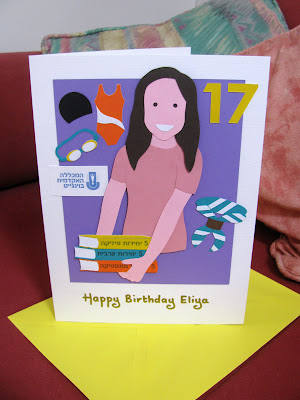
Eliya was turning 17. Her mum told me that she is a swimmer and is completing a Wingate* course to become an instructor. She was a madricha (youth leader) in the Scouts, or Tzofim as they are known in Hebrew, and is now a רשג״דית (ראש גדוד or senior counsellor) in charge of a whole age group. Finally, Eliya's mum told me that she is taking 5 units in Arabic, maths and physics at school. Israeli kids graduate from high school after taking exams available in different levels of difficulty, marked as units. 5 is the highest level. Eliya is obviously a smart young lady!
I have shown Eliya holding a pile of books. Each book shows the subject and number of units she is taking. To her right is a swimming costume, swim cap and goggles, along with the badge of the Academic College at Wingate. On her left I added her green and white striped tie, which shows her rank in the Israeli Scouts.
Mum told me that "She loved the card. It was perfect."
* The Wingate Institute, officially Orde Wingate Institute for Physical Education and Sports, is a sports training facility located south of Netanya, established in 1957. It is named after the senior British Army officer and supporter of Zionism, Orde Wingate. The facility serves as the host facility for numerous Israeli national teams.

** This post has been shared on Little Things Thursday, Thursday Favorite Things
PoCoLo
Sticky Mud and Belly Laughs

Monday, 7 February 2022

The Eurasian Jay

One morning, not long ago, I looked out of the window and saw a beautiful Eurasian Jay hopping around our front garden. This particular bird is a frequent visitor to our garden and one that I always enjoy seeing. Even though I was still in my dressing gown, I grabbed my camera and, after just a handful of shots, managed to get a lovely one. The jay is sitting on our garden fence, framed beautifully by one of our flowering bushes which is currently offering some bright orange berries, below.
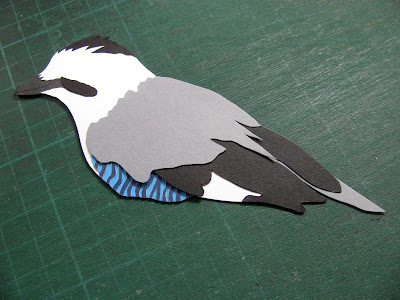
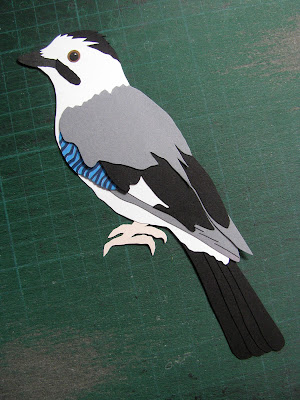
I posted the photo on my Facebook profile and it was popular! I decided that if my friends liked it so much, I was going to recreate the photo in paper. The piece I have made measures 20x25cm and, like much of my work, is created from layers of cut paper. The original is for sale and it is also available as print in my Etsy shop. Please send me an email or leave a comment if you are interested in purchasing the piece.
Now, a little bit about the Eurasian Jay. It is a relatively small corvid (a bird of the crow family), with a length of 34–35 cm and a wingspan of 52–58 cm. It has a stout black bill, a white throat with a thick black moustache. and the forehead and crown are white with black stripes. It has a black-and-white wing pattern with a prominent bright blue patch with fine black bars on the shoulder. The tail is mainly black.
The Eurasian Jay is an inhabitant of woodland, forest, parkland and gardens with larger trees, especially oaks. It feeds in both trees and on the ground, eating a wide range of invertebrates, acorns, seeds, berries and even young birds and eggs, bats and small rodents! It is typically rather shy and difficult to see well, but sometimes feeds out on open ground, as the one in our garden did. Pairs mate for life and work together to construct their messy-looking nests. Nests are built in trees and shrubs using twigs, with roots and hair for lining, where the female will lay four to five eggs.
The Eurasian jay is a common resident of Israeli towns and villages that have parks and green spaces, particularly in the north and central Israel.
Sticky Mud and Belly Laughs