Wednesday, 3 January 2024

Twenty Two

I never totally stopped creating after my youngest son died but it was hard for me to create "happy" pieces when I was, and still am, feeling so sad. Mister Handmade in Israel and I both decided that we wanted to forget our birthdays but our eldest son, Nadav, felt that he wanted to mark his day. In that case, he needed a special card made by mum!
He is now a year older but I am sharing his cards in consecutive order. His 23rd birthday card will follow soon.
Nadav had not long before discovered a love for diving and spent his 22nd birthday in Eilat, Israel's southernmost city, with his lovely girlfriend Hila. They had both done introductory dives a few months earlier.
Diving in Eilat offers the perfect way to explore the world-class coral reefs of the Red Sea off Eilat's shores. Eilat and the surrounding region of the Red Sea is one of the world's best diving regions and a great way to see the wonders of the underwater world, the coral, the marine life and more.
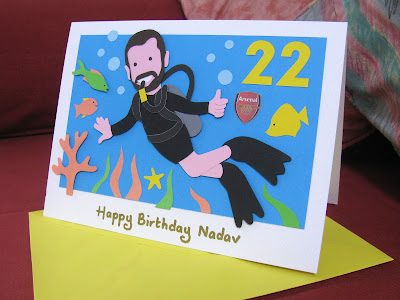
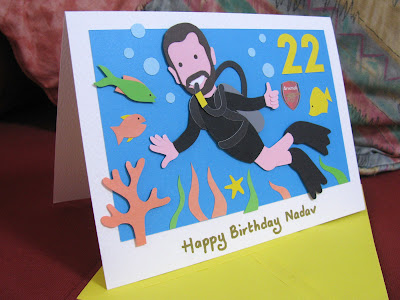
My card shows Nadav in his black wetsuit and flippers. He is surrounded by the beautiful blue water and colourful coral of the Red Sea. Some friendly fish have come to say hello too. The observant amongst you might notice the red Arsenal crest floating next to him in the water. As I have mentioned many times before, Nadav is obsessed with the Premier League football club and their crest just had to appear on his card. A big yellow number 22 marks his age.
His birthday card was spirited away in Hila's bag and presented to Nadav on the morning of his birthday. "Thank you very much" he wrote to me. "I like the card!"
PoCoLo
Sticky Mud and Belly Laughs

Wednesday, 6 December 2023

Chai חי

It has taken me quite some time to feel like sharing a piece of my artwork here. Whilst I never totally stopped creating after my youngest son died, it somehow didn't feel right sharing the pieces here. I didn't want my readers to think that everything was back to normal. Nothing is back to normal in my life and, with Gadi gone, it never will be. However, Gadi was a creative soul. He was the one I went to when I needed an opinion about something or if I wanted to check a colour or face resemblance. I really feel that he would want me to carry on with my art and this piece, created for a customer in the US who kindly reached out to me because she wanted to support an Israeli artist in these difficult times, seems exactly the right piece to re-start my sharing here. Chai (חי), which is pronounced as if you were saying "hi" in English, is a Hebrew word and symbol that means "life".
Chai is spelt with the Hebrew letters Het (ח) and Yud (י). The Hebrew letters of the word are often used as a visual symbol, frequently appearing on pendants and other jewellery. Chai also refers to the number 18. According to the gematria, which is a mystical tradition that assigns a numerological value to Hebrew letters, the letters Het (ח) and Yud (י) add up to the number 18. The Het has a value of 8 and the Yud has a value of 10. As a result, 18 is a popular number that represents good luck. At weddings, bar mitzvahs and other events Jewish people often give gifts of money in multiples of 18, symbolically giving the recipient the gift of "life" or luck.
In Hebrew, chai is often referred to in the plural form, chaim (חיים), hence the boy's name Chaim and the toast l’chaim (לחיים), which, as anyone who has seen Fiddler on the Roof knows, means "to life." 
Chai is heard in a BBC recording from 20th April 1945 of Jewish survivors of the Bergen-Belsen concentration camp five days after their liberation. This was the first Sabbath ceremony openly conducted on German soil since the beginning of the war. With people still dying around them, the survivors sang what would become the Israeli national anthem, "Hatikvah", "The Hope". At the end of "Hatikvah", British Army Chaplain Leslie Hardman shouts out, Am Yisra'el Chai! ("The people of Israel live!").
In the 1983 Eurovision Song Contest, which was held in Germany four decades after the Holocaust, Israel was represented with the song "Chai", performed by the Israeli singer, songwriter and actress Ofra Haza. The lyrics "Alive, alive, alive. Yes, I'm still alive" sadly resonate to this day. 
Should you be interested in purchasing a Chai papercut, just leave me a comment or use the email me button on the right hand side, below my social media buttons. Please be sure to note which colour backing paper you would like.
This particular papercut fits into a standard 8" x 10" frame with a mat opening of 4.5" x 6.5", though the size can be adjusted. You will receive this papercut UNFRAMED. The Chai papercut costs $40 + postage and packing.

Monday, 27 November 2023

Hod Hasharon Ecological Park

As I wrote on my previous blog post, Israel is at war and we are living through sad times. I have posted a couple of blogs about the situation but have decided now to share some posts about the beautiful side of the country I live in. A country filled with nature trails and historic ruins, gorgeous birds and flowers. The posts were written a year and a half or even two years ago, before I lost my youngest son. I haven’t felt like sharing them but now think that the time is appropriate to show you another side of Israel, a side that you will not currently see on the news.
This is Israel.
Hod Hasharon Ecological Park is located south of the city of Hod Hasharon, a city in the Central District of Israel. The park is home to a delicate ecosystem based on treated wastewater. You will find a large ecological lake and a flowing tributary of the Hadar Stream, three birdwatching hides, pedestrian paths and cycling trails. The park was inaugurated in 2018 and while it is not complete, it is already a beautiful place to visit. When development is complete, it will cover 1,400 dunams (140 hectares).
The lake, which is the main focus of the park, was planned as an ecological body of water. Underwater sandbanks resembling the natural stream beds of the area have been built on the 2 metre deep lake bed. These create a variety of habitats that sustain an entire ecosystem, from bacteria to algae to fish and amphibians. Birds that nest in burrows, such as the European Bee-eater and the European roller, have dug their nests in the banks and some 150,000 plants of about 30 species typical of the natural vegetation of the area have been have been planted there.
The source of the water for the lake and the park is the Hod Hasharon-Kfar Saba wastewater purification plant. The water receives its final purification in green basins south of the park and, from there, with its quality greatly improved, it is channelled to the lake. The water in the lake is replaced every five days. Pumps draw out the water and send it on to the Hadar Stream and the Yarkon River.
The hill on the west side of the lake is also made of recycled waste. Har Hazevel, or "Garbage Mountain", was a solid waste landfill until the early 1990s. It is still undergoing rehabilitation and is currently covered in mud and sand. An easy climb to the top boasts beautiful views of the park and the surrounding area. The route is already popular with cyclists and hikers.
Behind "Garbage Mountain" is an abandoned stone building, below, which will eventually be restored as the park's visitors centre. The Arab village of Abu Kishk once stood here and this building was a school built by the British in 1925 for the children of Bedouins living in this area. By the mid-1940s it had 108 students, including 9 girls. Today cactuses and almond trees grow nearby.
Hod Hasharon Ecological Park is a municipal park and when we visited there were a lot of people around, especially young kids. We enjoyed a picnic in the park then, after our climb to the top of "Garbage Mountain", the crowds began to die down and it became a lovely place for some birdwatching. However, if you can, I would suggest arriving at sunrise (during those hours, the birds are active, and there will be no people).
From the birdwatching hides I spotted little egret, cormorant, black-crowned night heron and squacco heron on the island in the centre of the lake and along the banks. During the season many migrating birds arrive in the area. The park provides them with a proper place to rest and "refuel" before continuing their journey.
The Hadar Stream was once a short, dry watercourse that channelled sewage between cultivated fields. Only rarely, after heavy rainfall, did water briefly flow through it. Soon after water began flowing through the Hadar Stream in 2014, species of fish appeared there that had adapted to the treated wastewater. Among these are the Eurasian carp and redbelly tilapia. They have been joined, whether as permanent or occasional inhabitants, by various amphibians, reptiles and mammals. You can see Caspian turtles and the Nile Softshell turtle in the lake, as well as Coypu (nutria), the large, semiaquatic rodent which we last saw at the Hula Lake.
Hod Hasharon Ecological Park is always open and you can visit at any time. At night there is artificial light. It is forbidden to start a fire or make barbecue at the park. Swimming and fishing are not allowed and dogs should be on a lead. Entrance is free.
I highly recommend a visit.
Sticky Mud and Belly Laughs