Sunday, 5 May 2019

The Southern Hills

One recent weekend Mister Handmade in Israel and I decided to take a walk in the hills south of the Buchman neighbourhood of Modi'in. (Actually, I decided we were going out for a walk and he was, somewhat reluctantly, dragged along!). The hills contain ruins of ancient settlements and provide beautiful nature hikes in the winter and spring. The decent amount of rain that we have had this winter meant that the spring flowers were blooming in force and, thanks to an unusually large migration from Saudi Arabia and Kuwait this year, there were butterflies galore, crossing Israel on their way to Europe.
The southern hills run along the south of the city of Modi'in, 300 metres above sea level. The hills are part of the Mediterranean ecological corridor that connects the Ramot Menashe region with the Jerusalem Hills and the Judean Foothills. What makes this area special is the link between the humid Mediterranean region in Israel's north with the arid Mediterranean region in Israel's south. The corridor enables the passage of animals, plants and pollinating insects, thus playing a critical role in conserving the biological diversity.
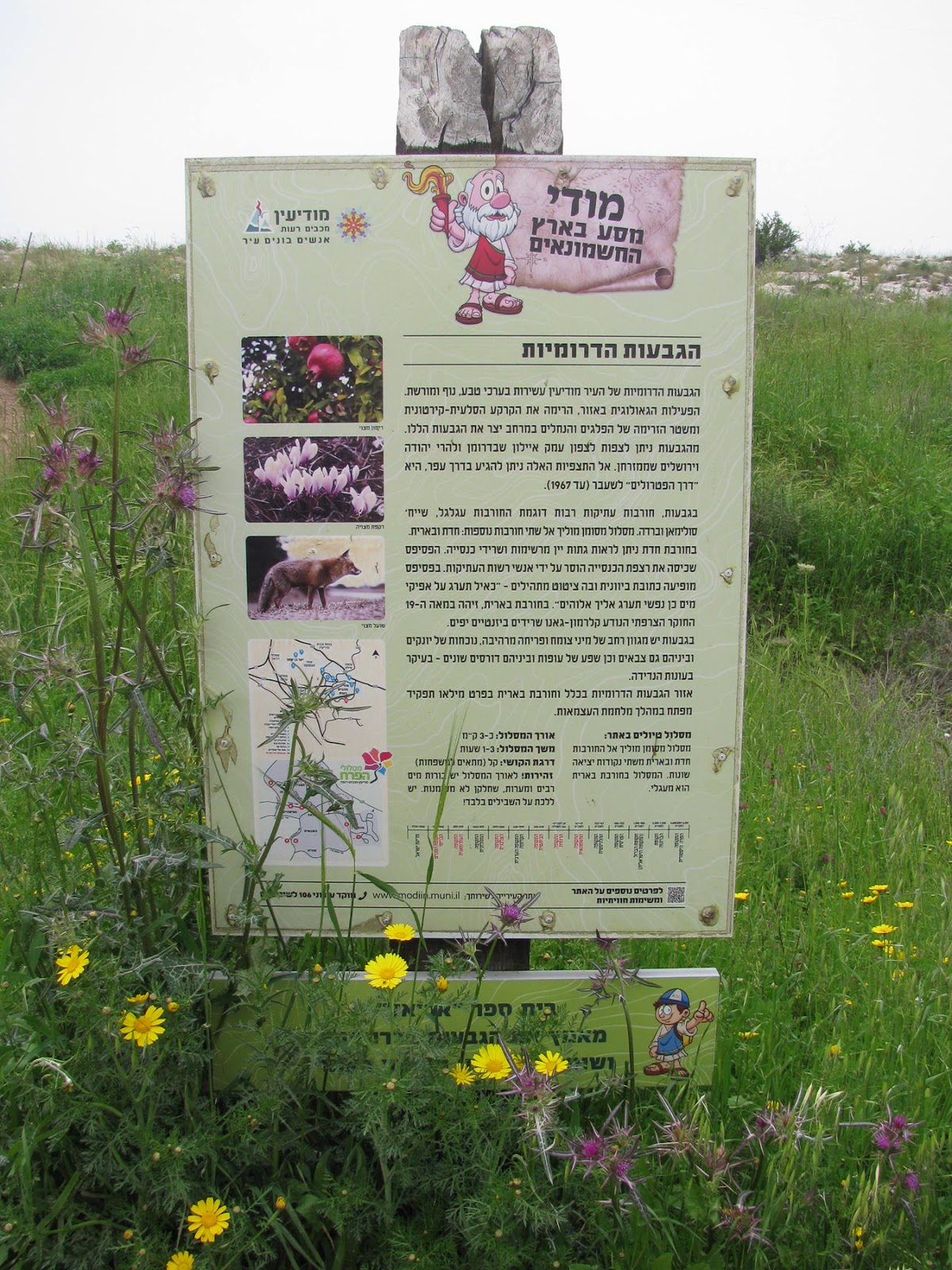
The hills provide several breathtaking lookout points over the Ayalon Valley, Park Canada and the Jerusalem Hills. There are also many archaeological artifacts - wine presses, oil presses, ritual baths, cisterns, caves, terraces and agricultural facilities that are proof of extensive agricultural and human activity in ancient times.
In 2014, students of the Society for the Protection of Nature in Israel (SPNI) exploration clubs conducted a survey of cisterns on the southern hills. The survey mapped 18 ritual baths, caves, and cisterns.
The remains of the village of Hadat, with findings from the Chalcolithic period and throughout most periods of history up to the early Islamic period, are perched on the top of one hill. At its centre is a Byzantine church, including fragments of columns and a round apse on the eastern side of the church. On the slopes there are cisterns, burial caves and hewn wine presses. A mosaic floor with a verse from Psalms was exposed in the church, but the mosaic is covered today.
The French explorer and archaeologist Clermont-Ganneau visited here in 1874 and told of ancient stone carvings engraved with crosses. These ancient lintels, which Clermont-Ganneau dated to the Byzantine period, were lost over the years and were probably plundered by antiquities robbers.
Be'erit, named for the well located at the foot of the hill, was named after the Arabic place name Al-Bawira or Bawiri. The well is extremely deep and allowed water to be drawn from the groundwater level. This well is the only one known throughout all of Modi'in's hills, as opposed to the many cisterns throughout the region where rain water was collected. Today the walls of the well are covered with concrete, which indicates that the reinforcement was done within the last century, probably during the British Mandate Period.
The remains of the village of Kanubah, a small Arab village conquered during the War of Independence, indicate that it was once a Byzantine-era farm. There is a burial cave and not far from it are the remains of a large building, a courtyard and cisterns. A giant palm tree rises up besides the stones, a trough hewn out of stone and a water channel. On the rocks are small round niches or cupmarks which were used to make olive oil by crushing the olives in them. This work was reserved for the elderly and the infirm during the harvest period.
Hikers can also, if they are lucky, observe a variety of wild animals for whom the hills serve as a habitat. Mountain gazelles, hyenas, jackals, porcupines, foxes, mongooses, badgers and various rodents live on the hills. Reptiles observed include fan-fingered geckos, stellagamas, Greek tortoises and Günther's cylindrical skinks (the last two being endangered species). A variety of birds of prey, as well as migratory birds such as storks and pelicans, and a host of songbirds can also be spotted.
As I previously mentioned, when we visited there was an influx of the painted lady, or Vannesa Cardui, species of butterfly, a type of migratory butterfly that travels in groups for distances of thousands of kilometres in the search for food. The large amounts of rain that fell in January and February not only in Israel but also in the Arabian Peninsula, turned the desert turned into fertile land. With their food sources drying up in the Arabian desert, the large numbers of butterflies migrated in search of food. The butterflies continue northward, crossing Cyprus and on to southern Europe to create their next generation.
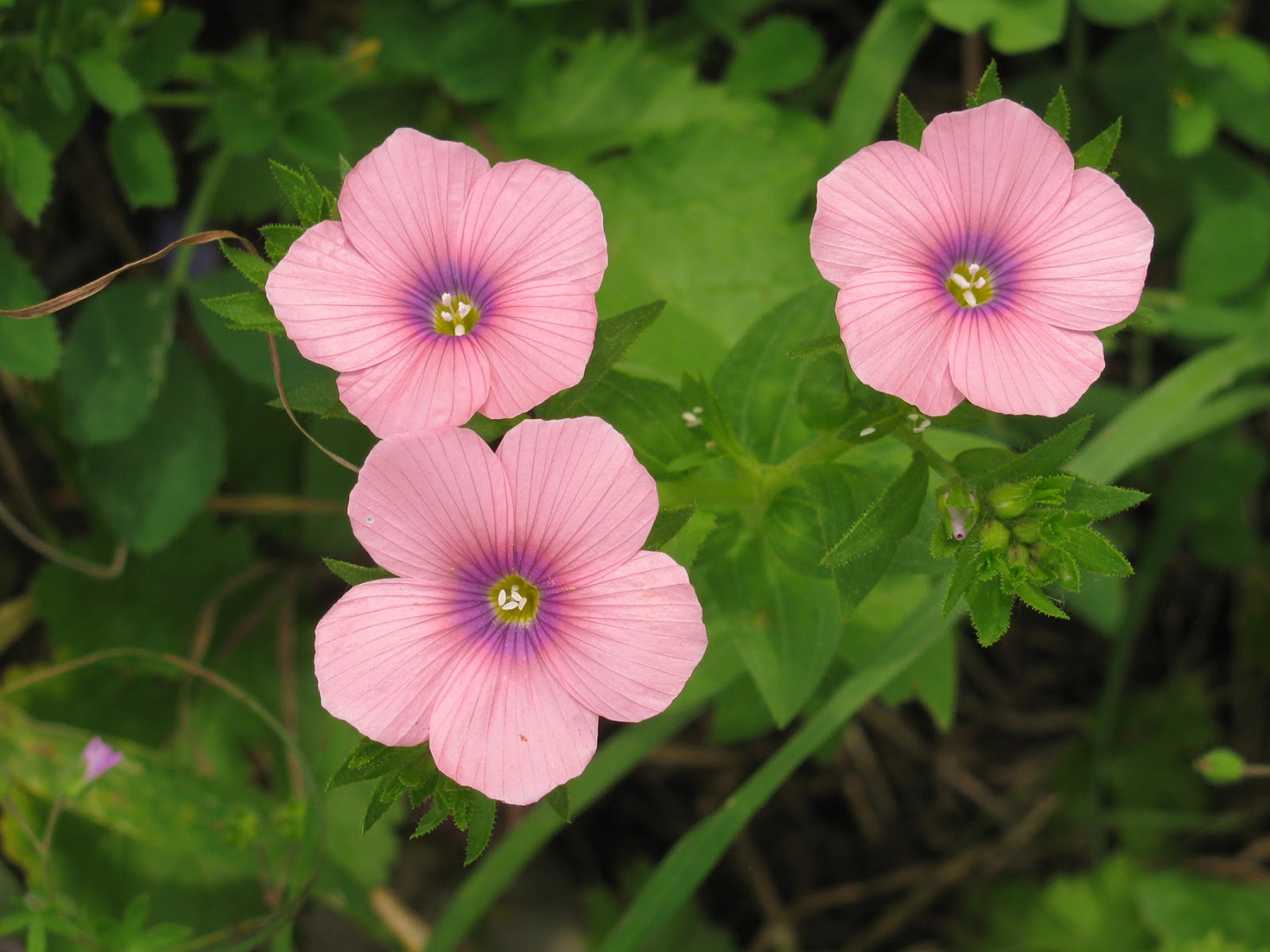
There are hundreds of species of plant life on the southern hills. In January and February the almond tree blossoms in the orchards of Be'erit and Kanubah, and red anemones can be seen in the valley between Hadat and Be'erit. In the winter and spring the undergrowth is in full bloom with pink cyclamen, winter crocus, Tuberous Hawkbit, Asphodelus ramosus, Syrian Iris and more. At the start of spring the Persian buttercup, cornflower, hairy pink flax, garland chrysanthemum, Jerusalem sage and purple clover bloom. In August and September, Sea Squill blossoms along the route.
Trees that can be found on the hill include carob and birch, alongside a range of orchard trees and large pine trees. The pine trees are estimated to be some 130 years old!
In addition to the area's landscape qualities and its importance in providing open spaces for Modi'in residents, this area, as mentioned above, is of critical importance on a national scale. The sequence of natural open spaces allows for biological diversity and the passage of wildlife between various habitats. In Modi'in's current master plan the southern hills are zoned as land for construction, but due to pressure exerted by the SPNI and local residents, and thanks to demonstrations in support of conserving the hills, there is now hope that the decision makers will rethink the future of the hills.

Monday, 29 April 2019

The Adventurer

A regular customer asked me to make a birthday card for her mum. She sent me a photo of her mum paragliding and asked me to use it as the inspiration. She told me that her mum is an amazing woman. Judging by the photo, she is obviously a very brave lady as well!
I created a paper version of mum free-flying, removing the instructor from the picture and collaging some photos of trees to create a matching background to the photo. I added a big red number 69 to mark her age. "Happy Birthday adventurer" was the greeting her daughter wanted on the card.
My customer was delighted with the card. "Your cards make her [mum] extremely happy, so thank you" she wrote to me. I was very pleased when she sent me this photo of mum opening the card on her birthday and then shared my work on Facebook. We both belong to an Israeli women entrepreneurs' networking group and my customer shared her excitement over the card there.
"Big shout out to Lisa Isaacs who yet again made my mum so happy even though we couldn’t be with her for her birthday. She makes the most beautiful cards that we all treasure."

Thursday, 25 April 2019

Shira

Blonde-haired Shira was turning 18 and it was her dad who asked me to make a card for her big day. She's a wiz at makeup, he told me, so that should be the main theme of the card. The beach, travel and champagne were also mentioned. Her favourite colour is bubblegum pink, he said.
I have shown Shira against a backdrop of a beach. She is holding some makeup in her hand and there is a lipstick, makeup brush and various makeup palettes - in shades of pink, of course - scattered around her. A plane represents her love of travel, whilst a bottle of champagne and a glass of the bubbly stuff are next to her. A big bubblegum pink number 18 marks her age.
"I think she really liked it [the card]" her dad told me.

Wednesday, 17 April 2019

Gin & Tonic and Solitaire

A customer asked me to make a birthday card for her friend. She needs to have a gin and tonic in her hand, she said. She also asked me to show her friend dancing and surrounded by music notes.
She sent me a couple of photos of the lady in question and in one of them she was wearing a red dress. I decided to show her wearing that dress on the card.
This Safta (the Hebrew word for Grandmother), below, has received my cards before. I have previously shown her making her famous chicken soup and outside her new holiday apartment in the Mediterranean resort city of Netanya. This time her daughter-in-law told me that Safta plays the card game Solitaire on her iPad every evening. I have shown her busy with her iPad and added some cushions and a few scattered playing cards in the background.
I am told that Safta loved the card.
Friday evening marks the start of Pesach, or Passover, and my family and I will celebrate the Passover Seder. You can read more about it in two of my previous posts here and here. 'Chag Pesach Sameach', a happy Passover festival, to all celebrating.

* This post has been shared on Wordless Wednesday Link Up, Wonderful Wednesday Blog Hop, Wednesdays Around the World, Little Things Thursday and Creatively Crafty.