Monday, 21 March 2022

Hamalachim - Shahariya Forest

Hamalachim - Shahariya Forest is located 4 km east of Kiryat Gat, a city in the Southern District of Israel. The forest was named after the Shahariya transit camp, which was established in 1956 slightly west of where the forest was planted. Residents of the transit camp started planting the forest on the initiative of the KKL-JNF (Keren Kayemeth LeIsrael - Jewish National Fund) in the same year. The Jewish community of Los Angeles raised funds for the project, and in honour of their contribution, the northern part of the forest was named Hamalachim Forest, which means the Angels Forest, true to the meaning of the city's name in Spanish - City of Angels. More recent development of the forest has been made possible because of friends of the KKL-JNF in the USA, Australia and Germany.
Along with picnic tables and playground facilities, the forest offers many hidden treasures including oil presses, wine presses and an ancient kiln, but on the day Mister Handmade in Israel and I visited, it was the carpets of rakefot, or Persian cyclamen, that we were searching for. They were not hard to find! The rounded hills and gentle slopes of the forest were absolutely covered with the blushing pink and white flowers. It was truly a sight to behold!
According to one of numerous fables, King Solomon, the king of Israel who built the first Temple in Jerusalem, wore a beautiful crown decorated with delicate cyclamen blossoms. Hundreds of years later, when the First Temple was destroyed, and the Jews were exiled to Babylon, they took with them the royal crown. The cyclamens that bedecked the crown were devastated by the tragedy and bent their heads in sorrow. And that is why, even today, cyclamen flowers bow their heads.
Of course, you may prefer the botanical explanation: The cyclamen's humble blossom protects its pollen from getting drenched in the rain.
Cyclamen are blessed with other natural defences as well: The undersides of their heart-shaped leaves are often purple, a colour that heats the leaves and helps keep cyclamen warm during freezing winter days.
We followed a trail through the forest, soon finding ourselves at the Keroa ruins, above. The Hebrew name retains the sound of the Arabic name, Khirbet Kharua, which means the Castor Ruins. The ruins include a building with three levels. The upper level includes cattle fences. The second level, from the Byzantine Period, originally included a building with two rooms, 16 metres long and 8 metres wide. Later, a third room was added on the eastern side of the building. The lower level of the building (the earliest) has not been excavated.
Archaeologists are not certain that the building is a synagogue dating back to the Talmudic period*. However, it faces Jerusalem and has a row of stones that could have served as benches for Jewish worshippers. Not only that, but there are five steps inside a large, plastered pit only a few metres away that lead to a rectangular bath. Since its dimensions conform to Jewish law, it seems likely that this is a mikvehor ritual bath, and that the building served as a Jewish house of worship.
We continued walking till we reached the Olive Press Trail on the northern slope of the forest. The trail features oil-making apparatuses dating back to the Talmudic period including large, round stones which were used to crush olives in the first stage of producing oil, and a b'dida, or small olive press. Crushed olives were turned into oil using this very small and primitive kind of oil press, a depression cut into natural rock. Wooden beams were placed on top of the b'dida and covered with special goat-hair baskets. The baskets were filled with crushed olives and topped with heavy rocks that exerted immense pressure. The resulting oil would drip into the b'dida. Several of these are found along the trail. Excavations also revealed benches carved in the bedrock and wine presses. 
We carried on exploring the slopes of the forest. There were many pretty flowers to be seen, including the beautiful and plentiful cyclamen, red anemone, the white and yellow Palestine Iris and more. We saw one family collecting huge mushrooms, which can be found among the trees. Olive, fig and carob trees can be seen in the valleys, where fertile soil accumulates. The carob trees were planted here early on, so that herds of sheep and goats could feed off their delicious fruit. Unfortunately, when a steady diet of carob caused the poor animals to miscarry repeatedly, the idea was discontinued. The chalk slopes of the forest are not so fertile, so the KKL-JNF planted conifer trees (Jerusalem pine and cypress) on them. These particular trees can thrive in harsh conditions.
An ancient kiln, estimated to be around 1,500-year-old, can also be seen in the forest. The kiln is a huge pit that was dug in the ground and lined with two layers of stones. Limestone was burned in it in order to produce plaster. Plaster was a mainstay used to insulate cistern walls, in plastering roofs and as a substitute for refrigeration. Food that is covered with plaster, like eggs and watermelons, can be preserved for a long period.
When the furnace was in operation, a structure resembling a dome was built above the pit, in which the limestone to be fired was placed. Inside the pit the fuel was kindled, most likely the Thorny burnet plant common to this area, which was inserted through a special opening. The furnace would burn for 3 to 6 days, depending on its size. When the dome started turning red, it was the sign that it was time to stop adding fuel. The opening was then closed and after a few days, when the furnace cooled, the walls were disassembled and the product was taken out - burnt lime.
The furnace is well preserved and has been restored. It is six metres deep and its diameter is about 4 metres.
In the open expanses that surround Hamalachim - Shahariya Forest, the vegetation that grows is primarily desert brush. The most ubiquitous shrub is the buckthorn, which is known for its tiny leaves, its round berries that turn black and its branches that end with thorny points. Other common plants are the aforementioned Thorny burnet and the common thatching grass, also known as Coolatai grass, which flourishes between the rocks. You can also find the wild marjoram, also known as hyssop, which is the main ingredient of the famous Middle Eastern spice za'atar. It is an endangered species and it is forbidden to pick it.

* The Talmudic period is the period of Jewish history from approximately 70 CE to roughly 640 CE. The start date is the destruction of the temple in Jerusalem and the end date is the Muslim conquest of Palestine.

Monday, 14 March 2022

A 30+30 Birthday

Howard was celebrating a special birthday. His wife wasn't sure if he would like the number of the birthday he was celebrating on the card but suggested I show it in a subtle way. Because he's an accountant, she thought it would be fun to show her husband holding a calculator with the numbers adding up to his age. He also loves the Montreal Canadiens, known as the Habs, a professional ice hockey team based in Montreal, she told me.
I showed her accountant husband sitting at his desk, with his laptop computer in front of him. He is holding up the calculator which, um, just happens to have the sum 30+30=60 on it 😉. Behind him I added the badge of his favourite ice hockey team, along with a stick and puck. Why is it called a puck? Hockey players way back when must've been some literary enthusiasts, because the puck is named after a character from Shakespeare. In "A Midsummer's Night Dream," Puck was a flighty and mischievous elf. Apparently the hockey puck can be pretty flighty too, sliding smoothly across the ice in all directions!
My customer posted the card on Facebook and, before I had even got out of bed that morning, I received an email saying "Love the card you did for Howard!"

Thursday, 10 March 2022

Big on Musicals

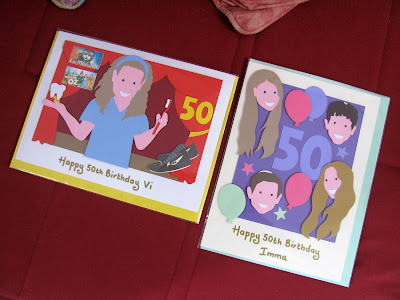
Aviva's husband asked me to make two cards for her 50th birthday. The first card was going to be from him. She is big on musicals, especially "Les Misérables" and "The Wizard of Oz", he told me. She likes running and she works as a dental assistant. He also wrote that she is totally addicted to social media but will claim that she isn't, so I suggested leaving that off the card 🤣
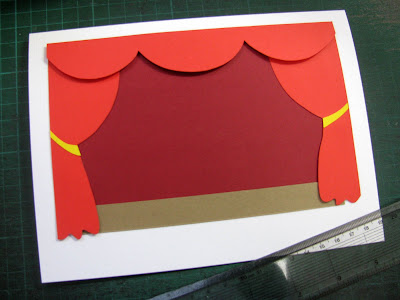
I decided to show Aviva standing in front of a stage, with the deep red curtains synonymous with theatres and the stage, behind her. She is wearing her blue dental assistant scrubs and is holding a toothbrush in one hand and a tooth in the other! Next to her are her running shoes, copied from a photo her husband sent me, and behind her are the theatre posters for "Les Mis" and her long-time love, "The Wizard of Oz". A big yellow number 50 marks her age.
The second card was from the couple's four kids. Her husband asked me to put their faces on the front of the card, along with the greeting "Happy 50th birthday Imma". Imma is the Hebrew word for mum. I have made cards for some of them before, so knew that their eldest daughter is blonde, whilst the younger daughter is a redhead, or gingie, as they are known here in Israel. The boys both have brown hair. I added a big purple number 50 to the card and some birthday balloons too.
Aviva wrote to thank me for the amazing cards and to tell me that she absolutely loved them! She then kindly shared them on Facebook, along with this amazing review:
"Wanted to give a big shout out to 2 amazing women in Modi'in who helped make my birthday weekend extra special. Lisa Isaacs for her fabulous cards. I have bought many cards from Lisa but it still amazes me how much detail she puts into the cards and how much the people on the cards REALLY do look like the actual person... So thank you to both of you."

* This post has been shared on Little Things Thursday, Creatively Crafty Link PartyCrafty Creators Link Party and Thursday Favorite Things.
PoCoLo